
Our Blog
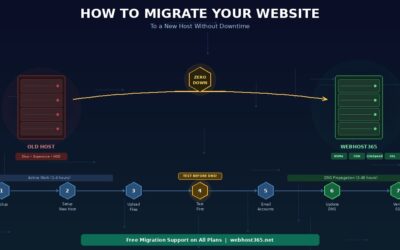
How to Migrate Your Website to a New Host Without Downtime
You can migrate your website to a new hosting provider without a single minute of downtime if you follow seven steps in the right order. First, create a full backup of your current site including files and database. Second, set up your account on the new host. Third,...
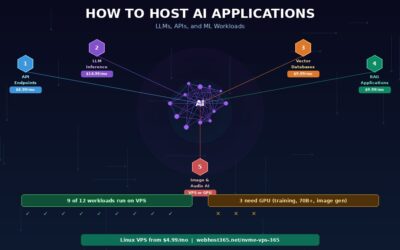
How to Host AI Applications: LLMs, APIs, and ML Workloads
Not every AI application needs a GPU cluster or a $500 per month cloud bill. Many common AI workloads — small language models, vector databases, AI API endpoints, image classifiers, NLP pipelines, and retrieval-augmented generation systems — run efficiently on...
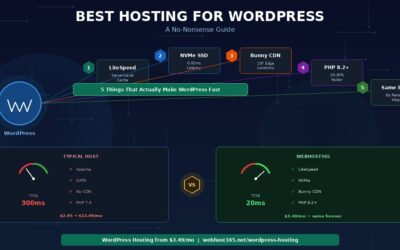
Best Hosting for WordPress: A No-Nonsense Guide
The best hosting for WordPress runs LiteSpeed with server-level caching, stores your files on NVMe SSD, includes a global CDN at no extra cost, supports PHP 8.2 or higher, and charges the same price at renewal as it does at signup. That combination makes WordPress...
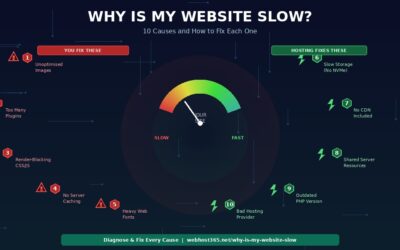
Why Is My Website Slow? 10 Causes and How to Fix Each One
Your website is slow because of one or more of these ten fixable problems: unoptimised images that are too large for the screen they display on, too many plugins or third-party scripts loading on every page, render-blocking CSS and JavaScript that delays content from...
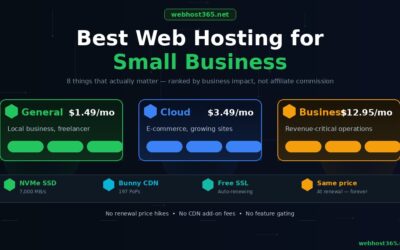
Best Web Hosting for Small Business: What Actually Matters
The best web hosting for a small business is the one that loads your site fast for every visitor, stays online around the clock, includes SSL and CDN without charging extra, provides professional email on your domain, and costs the same at renewal as it does at...
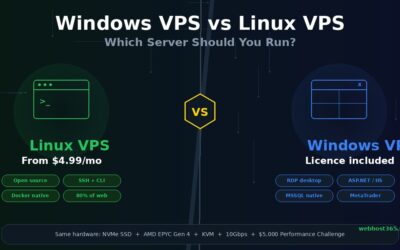
Windows VPS vs Linux VPS: Which Server Should You Run?
If your application requires Microsoft technologies — ASP.NET, MSSQL, Exchange, Active Directory, or Remote Desktop Protocol — you need a Windows VPS. For everything else — PHP, Python, Node.js, Ruby, Docker, WordPress, and the vast majority of open-source web...
For Developers
How to Migrate Your Website to a New Host Without Downtime
You can migrate your website to a new hosting provider without a single minute of downtime if you follow seven steps in the right order. First, create a full backup of your current site including files and database. Second, set up your account on the new host. Third,...
How to Host AI Applications: LLMs, APIs, and ML Workloads
Not every AI application needs a GPU cluster or a $500 per month cloud bill. Many common AI workloads — small language models, vector databases, AI API endpoints, image classifiers, NLP pipelines, and retrieval-augmented generation systems — run efficiently on...
For IT
How to Migrate Your Website to a New Host Without Downtime
You can migrate your website to a new hosting provider without a single minute of downtime if you follow seven steps in the right order. First, create a full backup of your current site including files and database. Second, set up your account on the new host. Third,...
How to Host AI Applications: LLMs, APIs, and ML Workloads
Not every AI application needs a GPU cluster or a $500 per month cloud bill. Many common AI workloads — small language models, vector databases, AI API endpoints, image classifiers, NLP pipelines, and retrieval-augmented generation systems — run efficiently on...