
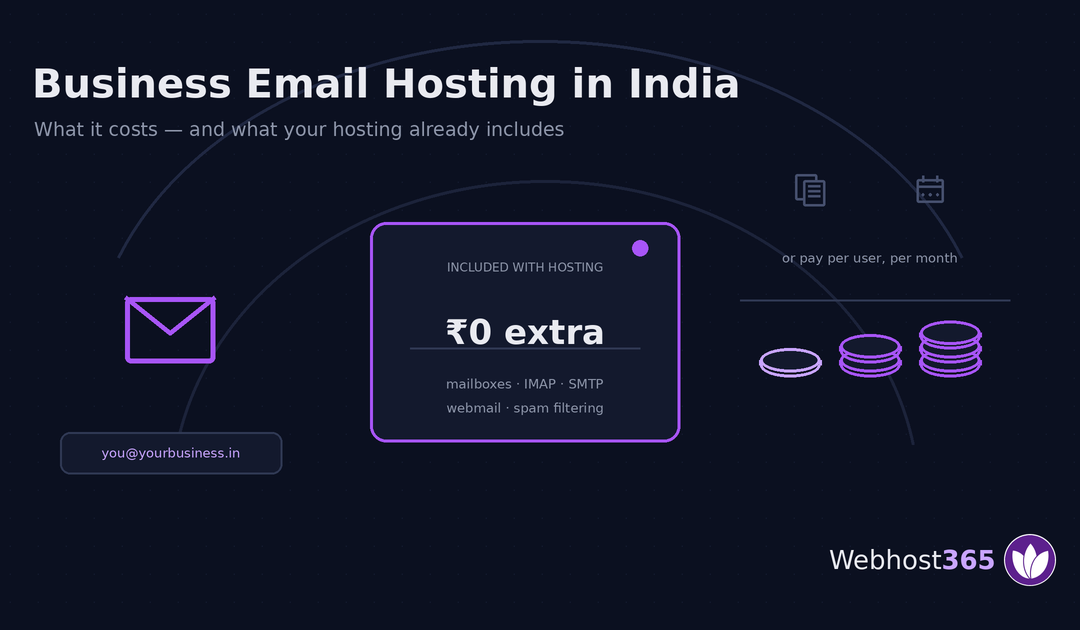
Business email in India costs anywhere from nothing to over ₹1,000 per user per month, and the quotes you find online contradict each other wildly. Many small businesses are paying per user for something their hosting already includes. This guide explains what the options really cost, why published prices disagree, and how to tell which one you need.
What Business Email Actually Is
Business email means a branded address at your own domain — priya@yourcompany.in rather than a Gmail or Rediffmail account. It signals that the business is real, it survives staff changes, and the address belongs to you rather than to whoever set it up.
Two quite different products get sold under that phrase, and separating them is the single most useful thing you can do before comparing prices. Our broader guide to email hosting versus web hosting covers the technical split in depth.
Email hosting is mailboxes and nothing else: addresses at your domain, IMAP, POP and SMTP so you can use Outlook or Apple Mail, webmail, spam filtering, forwarders and autoresponders.
A productivity suite is email plus documents, cloud storage, shared calendars, video meetings and an admin console. Google Workspace, Microsoft 365 and Zoho Workplace are suites.
Most Indian small businesses buy a suite and use the email. That is where the money goes — paying suite prices for email-only needs, per person, every month, forever.
Why the branded address is worth having
Trust is the obvious reason, and the one people mention. The practical reasons matter more.
Deliverability is better from a domain you control, because you can set the authentication records that decide whether your mail reaches an inbox or a spam folder. A consumer address gives you no such control.
Continuity is the other. If your business runs on an address tied to a personal account, you cannot move it, cannot delegate it, and cannot recover it if the account is locked. A domain-based mailbox is an asset the business owns, which is also why the domain itself matters — see our .in domain registration guide if you have not registered one yet.
What It Costs in India, and Why Nobody Gives You a Straight Answer
Search for business email pricing in India and you will find the same plan quoted at wildly different prices on different pages. That is not carelessness. There are five separate reasons the numbers diverge, and understanding them is how you get a real figure.
Plan naming changed. Google restructured its India lineup, so older articles quote plans under names that no longer exist while newer ones use the current names for the same products. Comparing a figure from one to a figure from the other compares nothing.
India has plans other countries do not. Google sells a self-service entry plan available only in India, priced well below the plan a reseller would sell you. A page quoting one and a page quoting the other are both accurate and cannot be reconciled.
GST is sometimes in the price and sometimes not. An 18% difference between two quotes is often just this. Always ask which you are looking at.
Annual billing costs less than monthly, typically by a meaningful margin, so a quote without a billing term is incomplete.
Where you buy changes the price. Buying direct, through an authorised reseller, or through a hosting company produces different rates for the same licence — and different invoices, which matters more than most buyers realise.
How to get a number you can rely on
Four steps, and they take about ten minutes.
Go to the vendor’s own India pricing page — Google Workspace, Zoho Mail or Microsoft 365 — rather than a blog. Every reseller page is selling something, including this one, and the vendor’s page is the only figure that is not marked up or out of date.
Note the plan name exactly as the vendor writes it today, because that is what you will be quoted against.
Check whether the figure includes GST, and add 18% if it does not.
Multiply by your actual number of mailboxes and by twelve. Per-user pricing is designed to feel small monthly; the annual figure for a team of five or ten is the number worth comparing.
The GST detail that costs real money
If you buy a foreign suite directly from the vendor, you may receive an invoice in dollars with no Indian GST line on it. No GST line means nothing to claim as input tax credit, so a GST-registered business absorbs the full cost.
Buy the same licence through an Indian entity and you get a rupee invoice with the CGST and SGST or IGST breakup, and a registered business claims that 18% back. The licence is identical. The invoice is not.
That is the same arithmetic we cover for hosting in our guide to web hosting price in India, and it applies to every recurring software subscription a business buys.
The Option Most People Miss
Before you price a suite, check whether you are already paying for email without knowing it.
Every paid managed hosting plan we sell — and the same is true of many hosts — includes business email at your domain at no extra cost. Not a trial, not a single mailbox, not an upsell: mailboxes at your own domain, included in the hosting price you already pay.
If your website is hosted somewhere, log into your control panel and look for an email or mail accounts section. A good number of small businesses find they have had this available for years while paying per user for a suite alongside it.
What included email gives you
Branded mailboxes at your domain, as many as your plan allows. Webmail in the browser, and IMAP, POP and SMTP so you can connect Outlook, Apple Mail, Thunderbird or the Gmail app on your phone. Spam and virus filtering. Forwarders, aliases and autoresponders. Catch-all addresses if you want them.
For a five-person business that sends and receives email and nothing more, that is the entire requirement.
What it does not give you
This is the part a hosting company has an incentive not to tell you, so here it is plainly.
No shared document editing. No Docs, Sheets or Slides equivalent. If two people need to work in the same spreadsheet simultaneously, included email does not do it.
No team calendaring. You get a mailbox, not a scheduling system with shared availability across a team.
No video meetings, no cloud storage, no device management, no enterprise admin console, no eDiscovery or retention policy tooling.
Storage is modest compared with a suite. Plenty for correspondence, not for treating your inbox as a filing cabinet for a decade of attachments.
If you need any of those, buy a suite. Included email is the right answer for email, and the wrong answer for collaboration.
Where ours sits
Free business email is part of every paid managed plan, starting at ₹146.02 a month including GST on General Hosting. That is the plan price, not an email price — the mailboxes come with the website.
So the honest comparison for a small business is not “our email versus Google Workspace”. It is “the email you already have versus a suite you may or may not need”. Our hosting plans list what each tier includes.
Which One You Actually Need
Four options, four cases where each genuinely wins.
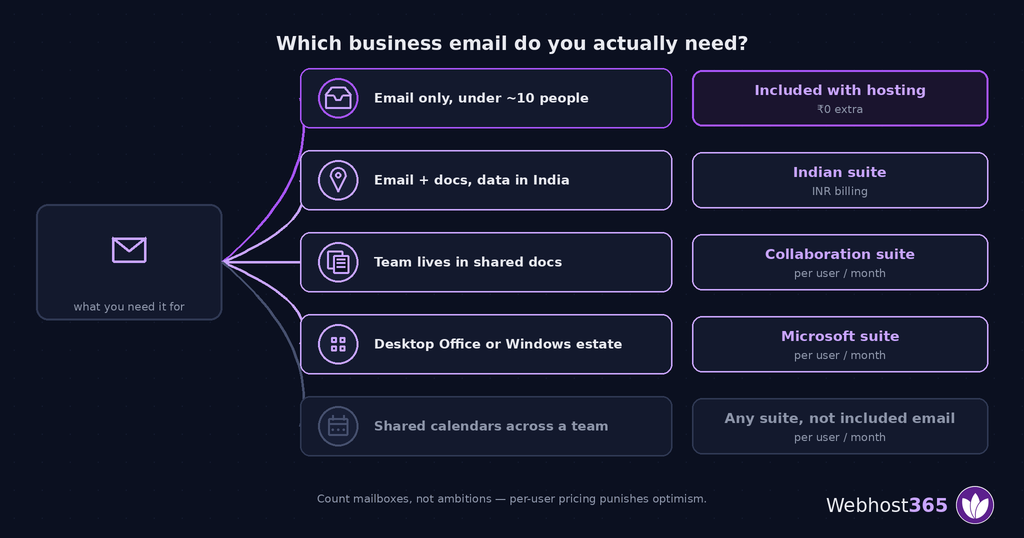
Included with your hosting — you have fewer than about ten mailboxes, you need email rather than collaboration, and you already pay for hosting. The marginal cost is zero, which no paid option can match.
Zoho — you want a suite but priced for an Indian business, and data residency matters to you. Zoho is an Indian company with Indian data centres, bills in rupees, and has a free tier for very small teams. For a business weighing where its data sits, that combination is hard to beat.
Google Workspace — your team already lives in Docs, Sheets and Meet, and the collaboration is the point rather than the email. Choose it when people will actually use the suite.
Microsoft 365 — you need desktop Office, or you are already in a Windows and Active Directory environment. Buying it for email alone is the most expensive way to get email.
The questions that actually decide it
How many mailboxes do you genuinely need? Count people, not aspirations. Per-user pricing punishes optimism.
Do you need documents and calendars, or just email? Be honest. Most small businesses that buy a suite for collaboration end up using email and a shared folder.
Does your data need to sit in India? If you handle sensitive customer information or operate in a regulated sector, this narrows the field quickly.
Do you already pay for hosting? If yes, check what it includes before buying anything.
Will you claim input tax credit? If you are GST-registered, a rupee invoice with a tax breakup is worth 18% to you, and that changes the comparison between an Indian vendor and a direct foreign purchase.
Running both is a real option
Nothing forces one choice for everyone. A common and sensible setup: the founder and sales team on a paid suite because they live in shared documents, everyone else on included mailboxes at the same domain.
Mail routing handles this without either group noticing. It is also how a growing business moves gradually rather than migrating everyone at once.
Where Your Email Lives, and Why It Matters Now
A mailbox is a database of personal data. Customer names, phone numbers, addresses, order details, complaints, bank details people should not have emailed but did. It accumulates for years and nobody ever deletes any of it.
That makes email squarely subject to the Digital Personal Data Protection Act. The retention obligation is the one that bites: personal data should be erased once the purpose it was collected for has been served. An inbox holding a decade of customer correspondence is difficult to square with that, and almost every Indian business has one.
Two practical consequences. Decide how long you keep mail, and apply it — a retention policy on the mailbox, not just on the CRM. And know where the mailbox physically sits, because you have to be able to answer that question. Our guide to the DPDP Act and your website covers the obligations in full, including which ones your provider can help with and which stay yours.
On location specifically: there is no general requirement today to keep Indian personal data in India, because the government has not notified a restricted-country list. But Zoho’s Indian data centres remove the question entirely, and Google and Microsoft largely store Indian customer data outside India. If data residency is a live concern in your sector, that difference is more decisive than any feature comparison.
Making Email Actually Arrive
The most common complaint about business email is that it lands in spam. The cause is almost never the provider. It is three DNS records that nobody set up.
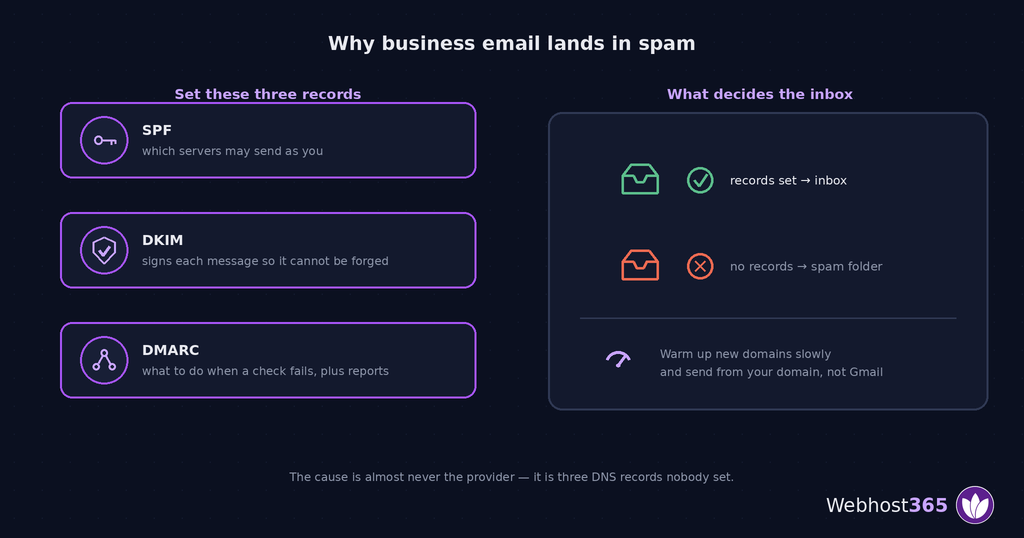
SPF lists which servers are allowed to send mail for your domain. Without it, anyone can forge your address and receiving servers have no way to tell.
DKIM signs each message cryptographically, so the recipient can verify it was not altered in transit and genuinely came from you.
DMARC tells receiving servers what to do when SPF or DKIM fails — nothing, quarantine, or reject — and sends you reports on who is sending mail as your domain.
Google and Yahoo both now require authentication for bulk senders, and enforcement has tightened across the board. A domain without these records is not merely unprotected; it is increasingly treated as suspicious by default. Our SPF, DKIM and DMARC guide covers setting them up properly.
Two things beyond the records. Send from your domain rather than a consumer address, because a From line of yourbusiness@gmail.com fails authentication the moment a filter checks it. And if you are sending to a list, warm up gradually — a new domain sending five hundred messages on day one looks exactly like a spam run.
Moving an existing mailbox
Migrating email is more forgiving than people expect, provided you do it in the right order.
Create the mailboxes at the destination first, with the same addresses. Copy the mail across using IMAP migration, which most providers offer as a tool — this can run while the old system is still live, because it is a copy rather than a move.
Only then change the MX records at your domain. That is the switch, and mail starts arriving at the new provider within minutes to a few hours as DNS propagates.
Leave the old mailboxes in place for a couple of weeks. Nothing is lost if something was missed, and you will find out quickly.
The thing people forget: forwarding rules, aliases and filters do not migrate. Neither do calendar entries if you are moving between suites. Write down what exists before you start, or rebuild it afterwards from memory, badly.
Final Thoughts
Business email in India is a decision most people make backwards. They pick a provider, then discover the cost per user per year, then find out their hosting included mailboxes all along.
The order that works: count how many mailboxes you genuinely need. Decide whether you need documents and calendars or just email. Check what your existing hosting already includes. Then price the real options from the vendors’ own India pages, with GST stated and multiplied out for a full year.
For a small business that needs email rather than collaboration, the included mailboxes on a hosting plan are usually the whole answer, and the marginal cost is zero. For a team that genuinely works in shared documents, a suite earns its price — and an Indian vendor with a rupee invoice will nearly always beat a direct foreign purchase once input tax credit is counted.
Whatever you choose, set SPF, DKIM and DMARC — part of the broader picture in our website security guide. It is free, it takes twenty minutes, and it matters more to whether your email arrives than which provider you picked.
Our hosting plans include business email at your domain from ₹146.02 a month with GST included, and our Noida team can tell you what your current plan already has before you buy anything.
FAQs
Anywhere from nothing to over ₹1,000 per user per month. Included mailboxes with a hosting plan cost nothing extra. Paid suites vary by plan, billing term and where you buy, and published figures differ widely — check the vendor’s own India pricing page, confirm whether GST is included, and multiply by your mailbox count for a year.
With most paid managed plans, yes — including ours on every paid tier. You get branded mailboxes at your domain with IMAP, POP, SMTP, webmail and spam filtering. Check your control panel before buying email separately; a lot of businesses are paying twice without realising.
Zoho if cost and Indian data residency matter: it is an Indian company with Indian data centres and rupee billing. Google Workspace if your team genuinely works in Docs, Sheets and Meet every day. If you only need email, neither may be necessary.
Effectively yes, if you host your website on a paid plan that includes mailboxes — the email comes with the hosting rather than as a separate charge. You still need to own the domain. Some vendors also offer free tiers for very small teams with reduced features.
Yes, 18% applies. Whether it appears as a claimable line on your invoice depends on where you buy. A direct foreign purchase can produce a dollar invoice with no Indian GST line and therefore nothing to claim; an Indian entity or reseller issues a rupee invoice with the CGST/SGST or IGST breakup.
Usually missing authentication rather than the provider. Set SPF, DKIM and DMARC records for your domain, send from the domain rather than a consumer address, and warm up new domains gradually before sending in volume.
The distinction between included hosting email and paid per-user platforms is especially useful here. Comparing the real monthly cost with storage, support, security, and scalability—not just the headline price—should help Indian small businesses avoid paying over ₹1,000 per user for features they may not need.
The distinction between included hosting email and dedicated services is especially useful—many small businesses may be paying per user unnecessarily. The explanation of why business email prices range from ₹0 to over ₹1,000 per user per month should help readers compare like-for-like plans.