
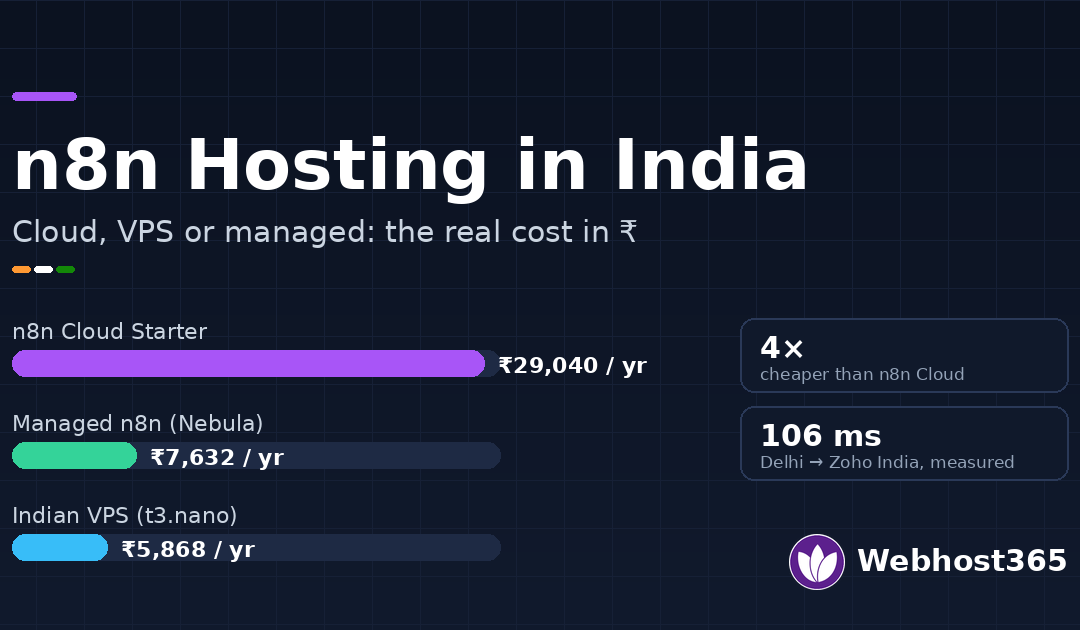
There are three ways to run n8n from India: n8n Cloud, a self-managed VPS, or a managed n8n plan from an Indian host. The sticker prices are easy to find. The real cost in rupees is not, because forex markup, GST and renewal pricing change the answer. This guide works it out, with measured numbers, and tells you when each option is the right one.
Which n8n Hosting Option Fits Which Indian Business
Start from two numbers: how many workflow executions you run a month, and how comfortable you are administering a Linux server. Everything else follows from those.
| Your situation | Best fit | Why |
|---|---|---|
| Under 200 executions a month, learning or testing | Free n8n hosting | Zero cost, nothing to manage, upgrade in place later |
| Under 2,000 executions a month, no server skills, no sensitive data | n8n Cloud Starter, or a managed Indian plan | Both remove the admin work; the managed plan bills in rupees with GST |
| 2,000 to 10,000 executions, no server skills | Managed n8n in India | n8n Cloud Pro costs several times more at this volume |
| Any volume, comfortable with Docker and SSH | Indian VPS, self-hosted | Unlimited executions for the price of the server; the admin is yours |
| Workflows that touch payment, health or KYC data | Indian VPS or managed Indian plan | Data, logs and backups stay in India under your control |
| Workflows that are mostly WhatsApp-driven | A USA node, Cloud or VPS | Meta’s API answers fastest from the United States, as our test below shows |
Two things the table does not say. First, n8n counts an execution each time a workflow runs end to end, so a workflow on a five-minute schedule alone uses roughly 8,700 executions a month, more than three times n8n Cloud Starter’s cap of 2,500. Our guide to n8n vs Zapier vs Make explains how each tool counts. Second, the cheapest option on paper is rarely the cheapest after year one. The rest of this guide shows why.
What n8n Cloud Really Costs in Rupees
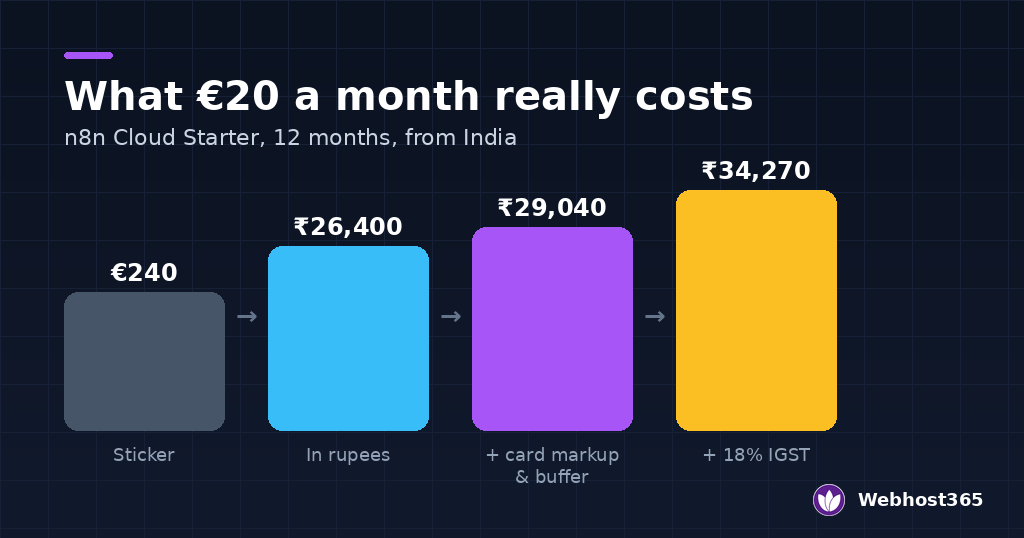
n8n Cloud is priced in euros: Starter at €20 a month and Pro at €50, both billed annually, with 2,500 and 10,000 executions a month respectively. Pay monthly instead and the rates rise to €24 and €60. Those are the numbers on n8n’s pricing page. The rupee cost is higher, for three reasons that apply to every dollar- or euro-priced service bought from India; our guide to web hosting price in India explains the same pattern.
The exchange rate and the card. Your bank converts the charge at its own rate and adds a foreign-transaction markup, typically 3.5%, with 18% GST on the markup. The rate also moves. We use ₹121 to the euro throughout this guide: today’s rate of about ₹110 plus a 10% buffer that covers the markup and a year of movement.
GST. A GST-registered business pays 18% IGST on a foreign subscription itself, under reverse charge, and can normally claim it back as input credit, so the net cost is unchanged but the cash goes out first. An unregistered individual is charged GST by the provider at checkout under the OIDAR rules in force since October 2023, and cannot claim it back.
Renewal. n8n Cloud does not have an introductory price, so the figure you pay in year one is the figure in year two. That is a point in its favour against hosts that triple the price at renewal.
| n8n Cloud plan | Executions / month | Sticker price | 12 months at ₹121/€ | With 18% IGST (individual) |
|---|---|---|---|---|
| Starter, annual | 2,500 | €20/mo | ₹29,040 | ₹34,270 |
| Starter, monthly | 2,500 | €24/mo | ₹34,850 | ₹41,120 |
| Pro, annual | 10,000 | €50/mo | ₹72,600 | ₹85,670 |
| Pro, monthly | 10,000 | €60/mo | ₹87,120 | ₹102,800 |
A registered business pays the first figure plus IGST it claims back; an individual pays the second. Either way, Starter is around ₹2,500 to ₹2,900 a month in practice, not the €20 on the banner.
Executions: why a five-minute schedule breaks Starter
n8n counts one execution every time a workflow runs from start to finish, whether it does anything useful or not. A workflow on a five-minute schedule therefore runs 288 times a day, which n8n’s own support article puts at roughly 8,600 to 8,900 executions a month. That is more than three times Starter’s cap of 2,500, from a single polling workflow. Webhook-triggered workflows only run when something happens, so they fit Cloud caps far better than schedules do. If your automation polls, price for Pro or look at self-hosting, where executions are limited only by the server.
Self-Hosting n8n on an Indian VPS: Intro Price vs Renewal
Self-hosting replaces the per-execution cap with a server you own. The headline prices are low; the catch is that most Indian hosts quote an introductory rate that requires a long prepay and renews much higher. Here are the entry plans suitable for n8n from the main Indian providers, checked on 6 November 2026, with the renewal rate alongside. Prices exclude 18% GST unless stated.
| Provider and plan | Spec | Intro price | Renews at | Prepay required | Year 1 | Year 2 |
|---|---|---|---|---|---|---|
| Hostinger India KVM 1 | 1 vCPU, 4 GB, 50 GB NVMe | ₹599/mo | ₹999/mo | 24 months (₹14,376 upfront) | ₹7,188 | ₹7,188, then ₹11,988 |
| MilesWeb n8n SM-L1 | 1 vCPU, 4 GB, 50 GB NVMe | ₹549/mo | ₹949/mo | Annual | ₹6,588 | ₹11,388 |
| Host IT Smart n8n VPS 1 | 1 vCPU, 4 GB, 50 GB SSD | ₹299/mo | ₹600/mo | 24 months | ₹3,588 | ₹3,588, then ₹7,200 |
| DigitalOcean, Bangalore | 1 vCPU, 2 GB | $12/mo | Same | None | ₹14,260 at ₹99/$ | Same |
| Webhost365 t3.nano, Delhi | 2 vCPU, 4 GB, 25 GB NVMe | ₹489.02/mo, GST included | Same price | None | ₹5,868 | ₹5,868 |
Three things to read from the table. The year-two column is the one to budget from, because that is the price you will pay for as long as you keep the server. Dollar-priced providers look competitive until the markup and GST are added, and they bill in a currency that moves. And the gap between the cheapest and the most expensive Indian VPS here is about ₹6,000 a year, which is less than one month of n8n Cloud Pro.
Our Indian VPS plans are priced in rupees with GST included, bill monthly with no prepay, and renew at the sign-up price. The t3.nano above is the server we measured n8n on.
How much RAM n8n needs
Four gigabytes. On the t3.nano, n8n used 384 MiB idle and 756 MiB running ten workflows at once, with nothing failing, so 4 GB leaves ample headroom and 2 GB suits only light use with small payloads. Disk matters more than people expect, because execution history grows with every run; the measured figures and the sizing table are in our n8n requirements guide.
Latency: India, USA and Frankfurt to the APIs Indian Businesses Use
n8n Cloud stores and runs everything in Frankfurt, Germany; n8n says so in its pricing FAQ, and there is no Indian region. So every call a cloud workflow makes to an Indian service crosses to Europe and back. Microsoft’s own Azure latency statistics put the median round trip from Central India to Germany West Central, where n8n Cloud lives, at 140 ms. That is before the API does any work.
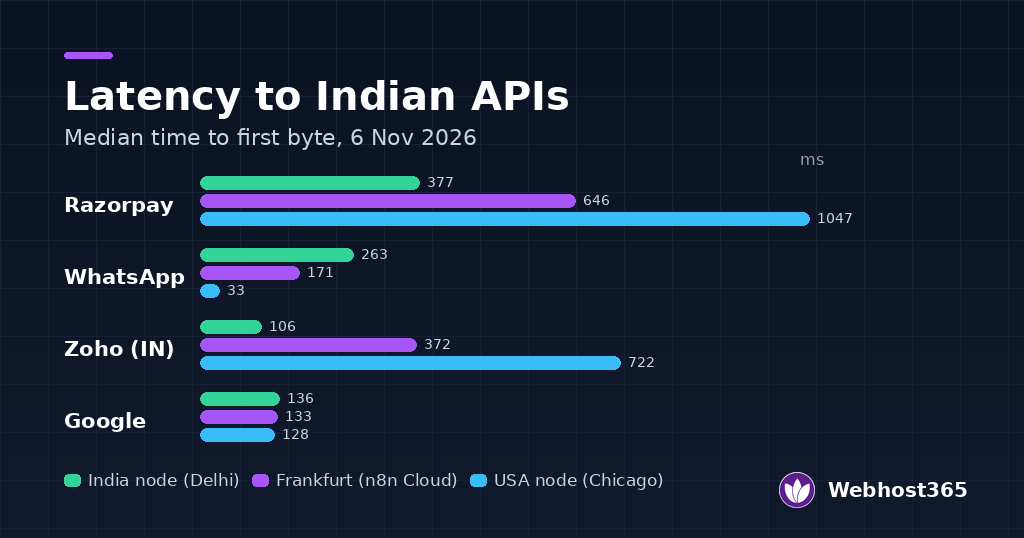
We wanted real numbers rather than a theory, so we measured. On 6 November 2026 we made 20 fresh HTTPS requests to four APIs from three locations: our India node in Delhi, our USA node in Chicago, and a server in Frankfurt standing in for n8n Cloud. A fresh connection each time is what a webhook call looks like in practice. The figures are median time to first byte, in milliseconds.
| Request from | Razorpay | WhatsApp (Meta) | Zoho (India DC) | Google APIs |
|---|---|---|---|---|
| India node, Delhi | 377 | 263 | 106 | 136 |
| Frankfurt (n8n Cloud) | 646 | 171 | 372 | 133 |
| USA node, Chicago | 1,047 | 33 | 722 | 128 |
Three things stand out.
Indian-hosted APIs strongly favour an Indian server. Zoho’s India data centre answers Delhi in 106 ms, Frankfurt in 372 and Chicago in 722. Razorpay follows the same pattern. For a payment, CRM or invoicing workflow, n8n Cloud is roughly two to three times slower per call than a box in India, and a workflow makes many calls.
Meta’s WhatsApp API favours the United States. Chicago reaches graph.facebook.com in 33 ms; Delhi takes 263. If your automation is mostly WhatsApp-driven, a US server is the better home, which is why we offer both locations rather than claiming India wins everything.
Google is the same everywhere. Google’s APIs answer from the nearest edge, so all three locations sit near 130 ms. Location does not matter for Google Sheets or Gmail workflows.
One note on method. Razorpay’s root endpoint responds slowly from every location, including Delhi, which suggests a firewall or redirect in front of it. The relative gap is what matters, and it held across two separate runs. Anyone can repeat this test with curl; the command is at the end of this guide.
Does n8n Data Have to Stay in India? DPDP and RBI, Honestly
Most Indian hosting pages tell you that the DPDP Act requires your n8n data to stay in India. That is not what the law says, and a guide that gets this wrong is not worth trusting on cost either. Here is the position as it stands in November 2026.
What the DPDP Act actually requires
The Digital Personal Data Protection Act 2023 and the DPDP Rules 2025 do not mandate storing data in India. Section 16 works the other way round: the government may restrict transfers to countries it names in a notification, and as of today it has named none. Section 16(2) keeps stricter sector rules in force where they exist. The Rules also phase in slowly. The substantive duties for ordinary businesses, including consent notices, security safeguards, breach reporting and retention limits, commence on 13 May 2027. Our DPDP compliance guide walks through each of them with the Gazette dates.
So running n8n Cloud in Frankfurt is legally permissible today for a typical Indian business. Anyone who says otherwise is selling something.
Where the RBI rule does apply
The one localisation rule with teeth is the Reserve Bank’s directive of 6 April 2018 on storage of payment system data, which requires the entire data relating to payment systems to be stored only in India. The RBI’s FAQ extends it to intermediaries, gateways and third-party vendors in the payments ecosystem. It binds payment system providers and the companies that work for them, not ordinary merchants.
For most readers the practical effect is this: if you sell through Razorpay, the gateway carries the obligation and your n8n workflow should not be storing card or account data at all. If you are a fintech, a payment aggregator, or a vendor processing payment data for one, the location of your n8n server and its execution logs is not a preference. Our guide to VPS hosting in India covers the rule in more detail.
The real reasons to keep n8n in India
None of this means location is unimportant. It means the reasons are practical rather than legal, and they are good ones.
- Execution logs hold your data. By default n8n saves the input and output of every node on every run. If a workflow processes customer records, those records sit in the execution database. On your own server you decide where that database lives, how long it is kept and who can read it.
- Breach response is faster when you hold the keys. From May 2027, the Rules require data fiduciaries to report breaches to the Board and affected individuals within 72 hours. That is far easier when the logs, backups and access records are on infrastructure you control.
- One vendor is simpler than three. A self-hosted or managed Indian instance means your automation, its database and its backups sit under one Indian contract, one GST invoice and one jurisdiction.
- Latency. As the measurements above show, Indian APIs answer an Indian server two to three times faster than they answer Frankfurt.
Put plainly: choose India for control, speed and simplicity. Do not choose it because someone told you the law forces you to.
The Hidden Cost of Self-Hosting
A VPS is the cheapest option on paper, and the one most people regret buying without knowing what comes with it. The server is the small part. The work is the rest.
Updates. n8n ships new versions every week or two, and security fixes arrive without warning. Someone has to read the release notes, pull the new image, restart the container and check that workflows still run. Skipping updates for three months is how instances get breached.
The database. n8n starts on SQLite, which is fine until it is not. With more than a few thousand executions a month, or more than one person editing workflows, you need PostgreSQL, and the migration is a job in itself; our SQLite to PostgreSQL guide walks through it with every error we hit. Our guide to self-hosting n8n with Docker Compose starts you on Postgres from day one for exactly this reason.
Disk. Execution history grows faster than people expect. In our own test, a workflow carrying about 500 KB per run grew the database from 2.4 MB to 96 MB in under 200 executions. Pruning is on by default, keeping 14 days or 10,000 runs, but you still have to size the disk and watch it. Our n8n requirements guide has the measured figures.
Backups. The platform backup covers the server, not the specific thing you care about, which is the database holding your workflows and credentials. A daily dump to somewhere other than the same server is the minimum, and it has to be set up and tested.
Exposure. n8n’s editor controls your credentials and can run arbitrary code. It needs HTTPS, a strong password, and ideally a firewall rule or VPN in front of it. Leaving it open on a public IP is the single most common mistake we see.
Budget two to four hours a month for a small instance once it is set up, and a day for the initial build. If you have those hours and the skills, self-hosting is the best value in automation. If you do not, the cost of a managed plan is cheaper than the cost of a server nobody maintains.
Managed n8n Hosting in India: What You Get and When It Beats Both
A managed plan is the middle path: n8n run for you on Indian infrastructure, billed in rupees, without the server to maintain. Ours comes in two tiers, both with unlimited workflows and users, full admin access, and a GST invoice.
| Plan | Executions / month | Price, GST included | 12 months | Compared with n8n Cloud |
|---|---|---|---|---|
| Nebula | 2,000 | ₹636.02/mo | ₹7,632 | About a quarter of Starter’s landed cost, for a similar cap |
| Stellar | Unlimited | ₹1,224.02/mo | ₹14,688 | About a fifth of Pro’s landed cost, with no cap at all |
We handle updates, backups, security patching and monitoring; you build workflows. The instance runs on our Delhi node, so the latency figures above are the ones you get, and your execution logs stay in India under one Indian contract. Renewal is at the same price.
When does it beat the alternatives? Over n8n Cloud, almost always on cost, and on latency for Indian APIs; Cloud wins only if you specifically want n8n’s own hosted platform, or your workflows are WhatsApp-heavy and you have no US option. Over a self-managed VPS, it wins whenever the two to four hours a month of maintenance are hours you do not have, or when nobody on the team is comfortable with Docker and Linux. If you do have those skills, the VPS is cheaper still and gives you root; if not, managed n8n in India is the plan to start on, and the free tier is the place to try it first.
Final Thoughts
Choosing where to run n8n in India comes down to three questions, in this order. How many executions a month, which decides whether n8n Cloud’s caps fit at all. Whether you can administer a server, which decides between a VPS and a managed plan. And what data flows through your workflows, which decides where the execution logs should live. Price comes last, and when it does, price it at year two with forex, GST and renewals included, not at the banner rate.
For most Indian businesses the answer is a managed plan in rupees or an Indian VPS, because the cost gap against n8n Cloud is large and the latency to Indian services is better. For a few, n8n Cloud is still right: low volume, no ops time, no sensitive data. And keep payment details out of execution logs wherever you host, because the RBI rule and plain good sense point the same way.
Repeat the latency test yourself
Run this on any Linux server. It makes 20 fresh HTTPS requests to each API and prints the median and 95th-percentile time to first byte in milliseconds.
for u in api.razorpay.com graph.facebook.com www.zohoapis.in www.googleapis.com; do
  for i in $(seq 1 20); do curl -s -o /dev/null --connect-timeout 10 --max-time 20 -w '%{time_starttransfer}\n' "https://$u/"; done \
  | sort -n | awk -v h="$u" '{a[NR]=$1*1000} END{printf "%-22s median %5.0f ms   p95 %5.0f ms\n", h, a[int(NR*0.5+0.5)], a[int(NR*0.95+0.5)]}'
done
FAQs
n8n Cloud Starter is €20 a month billed annually and Pro is €50, with 2,500 and 10,000 executions respectively. At ₹121 to the euro, the rate we use throughout this guide to cover card markup and a year of movement, that is ₹29,040 and ₹72,600 a year. A GST-registered business then pays 18% IGST under reverse charge and claims it back; an unregistered individual is charged it by the provider and cannot, taking Starter to ₹34,270 and Pro to ₹85,670. Either way, Starter works out at about ₹2,400 to ₹2,900 a month, not the €20 on the banner.
In money, yes, by a wide margin above a few thousand executions a month. An Indian VPS able to run n8n costs roughly ₹4,000 to ₹11,000 in the first year including GST, with unlimited executions, against ₹29,000 or more for n8n Cloud Starter. The honest comparison includes your time: a self-hosted instance needs a day to set up and two to four hours a month to update, back up and watch. If you have neither, a managed Indian plan sits between the two on price and removes the work.
No. The DPDP Act’s Section 16 lets the government restrict transfers to countries it names, and it has named none, so hosting in Frankfurt is permitted. The substantive DPDP obligations for ordinary businesses begin on 13 May 2027. The rule that does require Indian storage is the RBI’s 2018 directive on payment system data, which binds payment providers and their vendors rather than ordinary merchants. Choose Indian hosting for control, latency and simpler compliance, not because the law forces it.
In Frankfurt, Germany. n8n states in its pricing FAQ that hosted plans store data within the EU on servers in Frankfurt, and it does not offer an Indian region. Every call a cloud workflow makes to an Indian service therefore travels to Germany and back, which our measurements put at two to three times the latency of a server in India for Indian APIs such as Razorpay and Zoho.
From an Indian host, yes: our managed n8n and VPS plans are billed in rupees with a GST invoice, and registered businesses can claim the input tax credit. From n8n Cloud, a GST-registered business pays 18% IGST itself under reverse charge and claims it back, while an unregistered individual is charged GST by the provider at checkout under the OIDAR rules in force since October 2023. Either way, the headline euro price is not the final price.
A plan with 4 GB of RAM. When we measured n8n on our entry VPS, it used 384 MiB idle and 756 MiB running ten workflows at once, so 4 GB leaves comfortable headroom and 2 GB suits only light use. Our Indian VPS plans start at ₹489.02 a month with GST included, on NVMe storage at our Delhi node. Start there, and upgrade in place if your volume grows.