
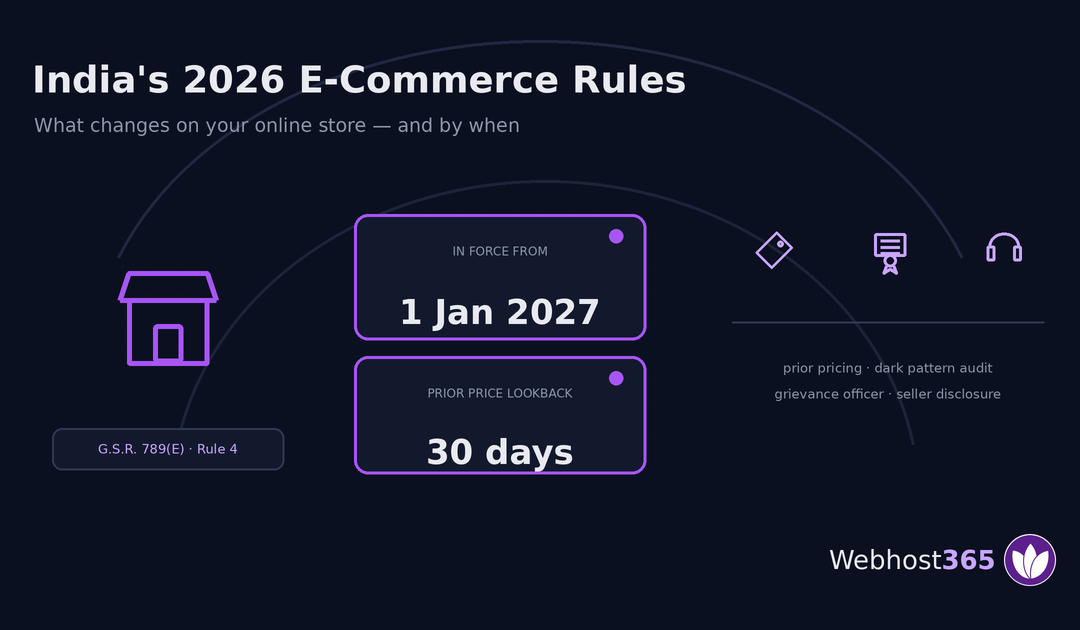
If you sell anything online to Indian consumers, new rules take effect on 1 January 2027. They change what your store must display: the prior price beside any discount, labelled sponsored listings, an annual dark-pattern audit certificate, and full contact details for a named grievance officer. This is a practical guide to what changes on your site, not legal advice.
What Changed, and When
On 9 September 2026 the Department of Consumer Affairs notified the Consumer Protection (E-Commerce) (Amendment) Rules, 2026 via G.S.R. 789(E), published in the Gazette of India Extraordinary as CG-DL-E-10092026-276125. They were made under clause (zg) of Section 101(2) of the Consumer Protection Act, 2019, and they amend the principal Rules of 2020 rather than replacing them.
They come into force on 1 January 2027. From publication, that is under four months.
Coverage so far has been aimed at Amazon, Flipkart and the quick-commerce platforms, which is understandable — several of the new obligations are squarely about marketplace behaviour. But the amendments also touch every e-commerce entity, and that phrase is broader than it sounds. If you run a WooCommerce store selling your own products, you are an e-commerce entity, and a set of these obligations lands on you.
You can read the notification yourself on the Gazette of India portal, and it is worth doing — it runs to four pages, and it is written in plainer language than most.
Does this apply to your store?
The Rules split obligations across four categories, and knowing which one you are in tells you which sections to read.
Every e-commerce entity — anyone selling goods or services over a digital network to Indian consumers. This is Rule 4, and it applies to you whether you run a marketplace or sell your own stock. Most of what changes for a small store is here.
Marketplace e-commerce entities — platforms hosting third-party sellers. Rule 5 adds obligations about seller disclosure, ranking transparency, use of collected data and bundled fees. If nobody else sells on your site, Rule 5 is not yours.
Sellers on marketplaces — if you sell through Amazon or Flipkart rather than your own site, Rule 6 is your section, and it now includes a new requirement to display your GSTIN or MSME registration number.
Inventory e-commerce entities — you own the stock and sell it directly through your own site. Rule 7 applies, and the 2026 amendment substitutes Rule 7(1)(a) with a longer list of information you must provide.
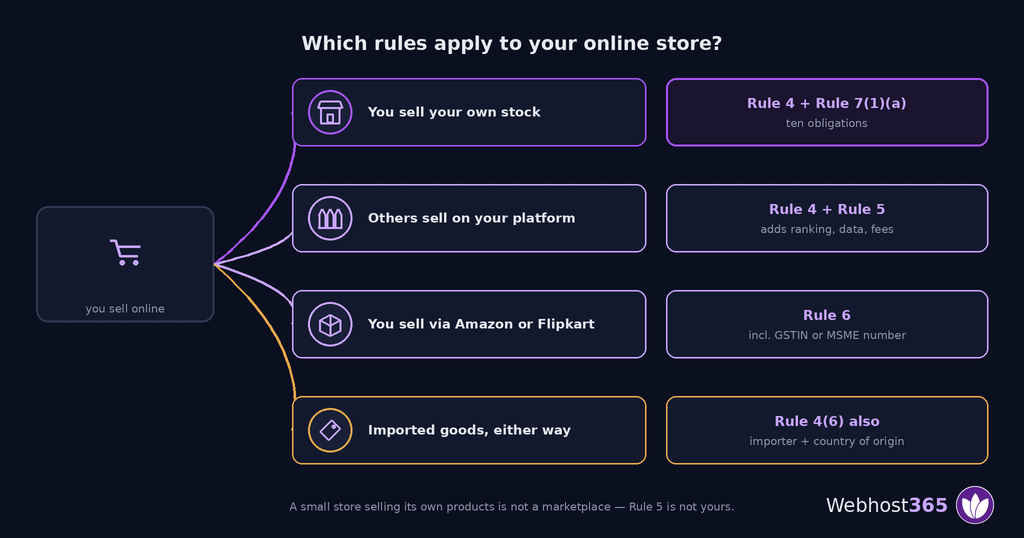
So the common case — a small Indian business selling its own products through its own website — is covered by Rule 4 plus Rule 7(1)(a), and not by Rule 5 at all. Several articles currently circulating imply otherwise, which would have small sellers building ranking-transparency disclosures they do not need.
Everything You Have to Change
Here is the complete set, with the rule that imposes it and who it applies to.
| # | What you must do | Rule | Applies to |
|---|---|---|---|
| 1 | Display legal name, HQ and branch addresses, website details, and email plus landline and mobile for customer care and the grievance officer | 4(2) | Every entity |
| 2 | Grievance officer acknowledges a complaint within 48 hours, gives the complainant a copy of the complaint as recorded, and resolves within one month | 4(5) | Every entity |
| 3 | For imported goods: name and details of the importer, and full country of origin per the Legal Metrology (Packaged Commodities) Rules, 2011 | 4(6) | Every entity |
| 4 | Become a partner in the National Consumer Helpline convergence process | 4(7) | Every entity |
| 5 | Do not mislead users by manipulating search results or search indexes | 4(11)(c) | Every entity |
| 6 | Sponsored listings distinctly identified with clear and prominent disclosures | 4(12) | Every entity |
| 7 | Show the prior price alongside any reduced price — prior price being the lowest in the 30 days before the announcement | 4(13) | Every entity |
| 8 | Invoice shows the seller’s name in the same font size as the platform’s name | 4(14) | Every entity |
| 9 | Comply with the Dark Patterns Guidelines 2023, run a yearly self-audit, and display the certificate prominently | 4(15) | Every entity |
| 10 | Seller details, ranking parameters in descending order of importance, and product information | 5(3) | Marketplaces |
| 11 | No use of collected data for own-brand sales or seller association without express affirmative consent | 5(6) | Marketplaces |
| 12 | No bundled fees for services unrelated to the platform (loyalty programmes exempt) | 5(7) | Marketplaces |
| 13 | Display GSTIN or MSME registration number | 6(5)(j) | Sellers on marketplaces |
| 14 | Accurate return, refund, exchange, best-before, warranty, delivery, return shipping cost, payment modes and grievance information | 7(1)(a) | Inventory entities |
If you sell your own products through your own site, rows 1 to 9 and row 14 are yours. Ten items.
Most are content: text on a page, fields on a product listing, a properly staffed inbox. Two are genuinely new work — the price history behind row 7, and the annual audit behind row 9. We come to both.
The 30-day prior price rule
This is the provision most likely to catch a small seller out, because satisfying it requires data you may not be keeping.
Rule 4(13) says that where you announce a price reduction, you must show the prior price alongside the reduced price. The Explanation defines prior price as the lowest price of the good or service thirty days prior to the announcement of the price reduction.
Read that carefully, because the obvious interpretation is wrong. The prior price is not what the item cost yesterday, and it is not your MRP or list price. It is the lowest price you actually offered at any point in the preceding thirty days.
Suppose you sell a kurta at ₹1,999 through most of a month, drop it to ₹1,499 for a three-day weekend sale, return it to ₹1,999, and then launch a festival offer at ₹1,299. The prior price you must display is ₹1,499, not ₹1,999 — because ₹1,499 was the lowest price offered in the previous thirty days. Advertising “₹1,999 ₹1,299” would overstate the discount.
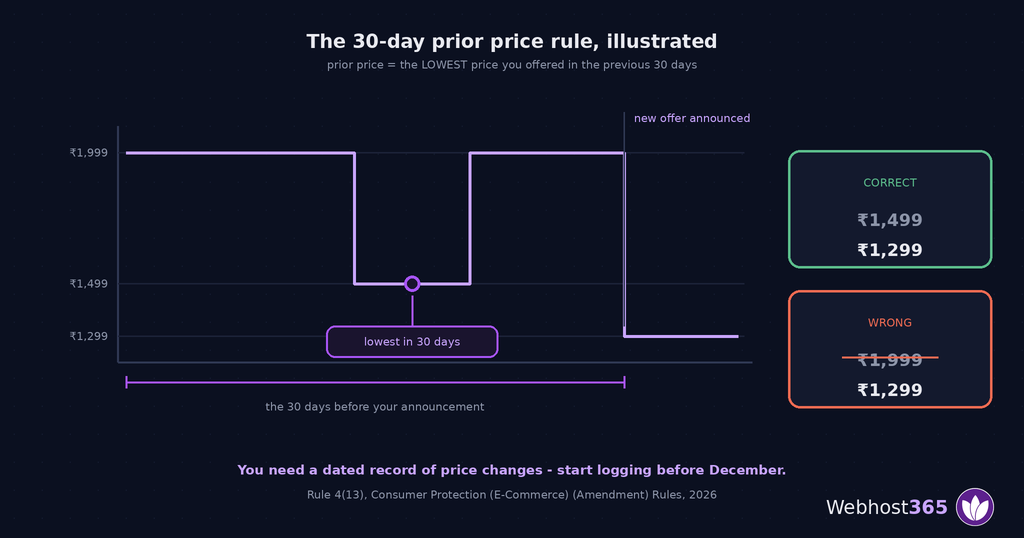
The practical consequence is that you need price history. Most small stores do not keep it: WooCommerce stores the current price and the sale price, not a dated log of what the price was on each of the last thirty days. Shopify is the same.
Three ways to solve it, in increasing order of effort:
Record it manually. If you have fifty products and change prices rarely, a spreadsheet with product, price and date is sufficient. Unglamorous and entirely adequate.
Use a price-history plugin. Several WooCommerce extensions log price changes with timestamps. Check that the log is queryable and exportable, since the point is to be able to answer the question later.
Write it into the database. For a larger catalogue, a table storing product ID, price and effective date, populated by a hook on price update, is a small piece of work that solves it permanently.
Whichever you choose, start now. The rule bites on 1 January 2027 and looks back thirty days, which means the data you need on day one has to have been recorded through December 2026. Beginning in January leaves you unable to comply for the first month.
Sponsored listings and search results
Rule 4(12) requires sponsored listings of products and services to be distinctly identified with clear and prominent disclosures. Rule 4(11)(c) prohibits misleading users by manipulating search results or search indexes having regard to the user’s search query.
Both apply to every e-commerce entity, though their practical weight sits with marketplaces. If you sell only your own products, you probably have no sponsored listings and no seller ranking to manipulate.
But do check two things. If you promote particular products into your own site search results or category pages in exchange for something — a supplier paying for placement, say — that is a sponsored listing and needs labelling. And if your search function returns results ordered by margin rather than relevance while appearing to be relevance-ranked, that is closer to Rule 4(11)(c) than you might like.
The amendment also redefines “ranking” under Rule 3(1)(j) to mean relative prominence or relevance given to sellers or goods, irrespective of the technological means used. That wording is deliberate: an algorithm, a manual sort order and a hand-curated homepage are all ranking.
Dark patterns, and the certificate you must display
Rule 4(15) is the one that creates genuinely new work. It requires every e-commerce entity to comply with the Guidelines for Prevention and Regulation of Dark Patterns, 2023, to conduct a yearly self-audit confirming the platform is free of dark patterns, and to display a certificate to that effect prominently.
The Guidelines were notified by the Central Consumer Protection Authority on 30 November 2023 under Section 18 of the Consumer Protection Act, and they specify thirteen dark patterns: false urgency, basket sneaking, confirm shaming, forced action, subscription trap, interface interference, bait and switch, drip pricing, disguised advertisement, nagging, trick question, SaaS billing and rogue malware. The full text and subsequent advisories are on the CCPA guidelines page.
Self-audit is not new in spirit — the CCPA issued an advisory in June 2025 asking platforms to self-audit within three months. What Rule 4(15) does is make it mandatory, annual, and publicly evidenced.
Four of the thirteen turn up constantly on small stores, usually without any intent to deceive:
False urgency. “Only 2 left!” when stock is fine. “Offer ends in 10:00” on a timer that resets when the page reloads. Both are common theme features, switched on by default.
Basket sneaking. Adding insurance, a donation or an extended warranty to the cart by default. If the customer did not choose it, it should not be there.
Confirm shaming. “No thanks, I don’t want to save money.” Guilt as a design pattern.
Drip pricing. Revealing delivery charges, handling fees or payment surcharges only at the final checkout step. The Rules also restrict bundled fees separately under Rule 5(7) for marketplaces.
The audit itself is straightforward for a small store: work through the thirteen against your actual checkout and product pages, write down what you found and what you changed, date it, and publish the certificate. It is a page on your site and an afternoon of honest review, not a consultancy engagement.
Seller, product and origin disclosures
Rule 7(1)(a), substituted by the amendment, lists what an inventory e-commerce entity must provide: accurate information on return, refund, exchange, best-before or use-before date, warranty and guarantee, delivery and shipment, cost of return shipping, modes of payment, and the grievance redressal mechanism.
Two of those are commonly missing. The cost of return shipping is frequently left vague until a customer tries to return something. And best-before dates apply if you sell anything perishable, subject to the Food Safety and Standards Act, 2006 — worth noting if you sell food, cosmetics or supplements.
For imported goods, Rule 4(6) requires the importer’s name and details plus the full country of origin, as provided under the Legal Metrology (Packaged Commodities) Rules, 2011.
Grievances, and the National Consumer Helpline
Rule 4(2) requires prominent display of your legal name, the principal geographic address of your headquarters and all branches, your website details, and contact details — email, landline and mobile — for both customer care and your grievance officer.
Rule 4(5) sets the process: acknowledge within 48 hours, give the complainant a copy of the complaint as recorded, and resolve within one month.
Worth being accurate here, because several articles have it wrong: the 48-hour and one-month timelines are not new. They existed under the 2020 Rules. What the amendment adds is the obligation to hand the complainant a copy of the recorded complaint, which changes the practice — complaints now have to be recorded properly rather than handled informally.
Rule 4(7) is new: every e-commerce entity must become a partner in the convergence process of the National Consumer Helpline. Context for why this appeared — the NCH received 17,71,622 grievances in 2025, of which 5,11,196, around 29%, related to e-commerce.
For a small business, the practical shape of this is a named person, a monitored mailbox at your own domain, and a simple log of complaints with dates. A branded email address matters more than it sounds — a grievance officer contact at gmail.com undercuts the whole disclosure.
What This Means Technically
Most of this article is content and process rather than infrastructure, and it would be dishonest for a hosting company to pretend otherwise. Four things do touch how your store is built and hosted.
Price history storage. Covered above, and the only genuinely new data requirement. A spreadsheet, a plugin, or a database table — but something that records what the price was and when, starting before January.
A grievance page and a monitored mailbox. Rule 4(2) needs a page carrying your legal name, addresses, website details and contact numbers for customer care and the grievance officer. Rule 4(5) needs someone reading the inbox within 48 hours. The page is trivial; the mailbox is a commitment.
Somewhere to host the audit certificate. Rule 4(15) requires it displayed prominently, which in practice means a page linked from your footer, dated, and replaced each year.
Staging, to test the checkout changes. Several of these edits touch the cart and checkout — removing pre-ticked add-ons, surfacing delivery charges earlier, adding prior-price display. Making those changes directly on a live store is how a working checkout becomes a broken one during festival season. Test on a copy, then deploy.
That last point is the only one where hosting genuinely matters. If your plan does not include staging, or you have never restored a backup, this is a good moment to fix both — our backup strategies guide covers testing a restore properly, and our business hosting plans include staging and daily backups.
Everything else on the list is text on a page. That is good news: it means this is a weekend of careful work rather than a development project.
What Happens If You Do Nothing
The Rules operate through the Consumer Protection Act, 2019, and enforcement sits with the Central Consumer Protection Authority. The CCPA can investigate, order the discontinuance of unfair trade practices, and impose penalties under the Act.
Dark patterns in particular are already being enforced rather than merely discussed, with penalties issued against platforms in aviation, e-commerce and digital health. Those are marketplace-scale cases rather than small-seller ones, but they establish that this is a live enforcement area and not a dormant guideline.
The realistic risk for a small store is not a headline penalty. It is a consumer complaint routed through the National Consumer Helpline, a CCPA enquiry asking what your grievance process is and where your audit certificate is, and having no answer because nothing was ever written down.
That pattern should be familiar if you have read our guides to the DPDP Act and website security. Across all three frameworks, documentation is what separates a business that is broadly compliant from one that cannot demonstrate anything.
Final Thoughts
Four months is enough time, and it is not a lot of time.
The order that works:
This week — work out which entity type you are. If you sell your own products through your own site, you need Rule 4 and Rule 7(1)(a), and you can ignore the marketplace sections that most articles lead with.
This month — start recording price history. This is the only item with a deadline before the deadline, because the thirty-day lookback on 1 January needs data from December.
Before December — fix the product pages: return, refund, exchange, warranty, delivery, return shipping cost, payment modes, grievance mechanism. Add the disclosure page with your legal name, addresses and grievance officer contact. Set up the mailbox and decide who reads it.
December — run the dark-pattern audit against the thirteen, change what needs changing, and publish the certificate. Test the checkout edits on a staging copy before they go live.
None of this is difficult. It is simply work that has to be done by a date, by someone who knows it exists — which, for most small Indian sellers right now, is the problem.
This guide is not legal advice. We are a hosting company, and what we can speak to with authority is the technical half — price history storage, staging, backups, where pages live. Whether and how these Rules apply to your specific business is a question for a professional, and the notification itself is short enough to read.
If the technical side is what you need, our Noida team can tell you what your current setup already supports.
FAQs
Yes, if you sell goods or services online to Indian consumers. Rule 4 applies to every e-commerce entity regardless of size, and Rule 7(1)(a) applies to inventory e-commerce entities — businesses selling their own stock through their own site. The marketplace-specific obligations in Rule 5 do not apply unless third parties sell through your platform.
Under Rule 4(13), when you announce a price reduction you must display the prior price alongside the reduced price. Prior price is defined as the lowest price at which you offered the item during the thirty days before the announcement — not your list price, and not yesterday’s price. It requires keeping a dated record of price changes.
1 January 2027. They were notified on 9 September 2026 via G.S.R. 789(E) and amend the Consumer Protection (E-Commerce) Rules, 2020.
Rule 4(15) requires every e-commerce entity to comply with the Dark Patterns Guidelines, 2023, conduct a yearly self-audit confirming the platform is free of dark patterns, and display a certificate prominently. For a small store this means reviewing your checkout and product pages against the thirteen specified dark patterns, recording what you found and fixed, and publishing a dated certificate on your site.
Only if you have them. Rule 4(12) requires sponsored listings to be distinctly identified with clear and prominent disclosures. If you sell only your own products and nobody pays for placement, there is nothing to label — but if a supplier pays to appear higher in your search or category pages, that is a sponsored listing.
Add a disclosure page with your legal name, addresses, website details and grievance officer contact. Start logging price changes so you can show the thirty-day prior price. Complete the product information fields, including cost of return shipping. Remove pre-ticked add-ons and false urgency timers. Surface delivery charges before the final checkout step. Run the dark-pattern audit and publish the certificate. Set up a monitored mailbox and a complaint log.