

Imagine this: You’ve spent months perfecting your SEO strategy, your content is top-tier, and your backlink profile is pristine. But in the Google Search Console, your Core Web Vitals are bleeding red. Even worse, while your site loads in a snap from your office, users on the other side of the globe are staring at a blank screen for five seconds before bouncing, not any more, presenting Integrated CDN hosting.
In today’s time, distance is the silent killer of conversions. If your server is in New York and your visitor is in London, physical laws dictate a delay that no amount of code optimization can fix. This is where the gap between “standard hosting” and “performance-integrated hosting” becomes a canyon.
Many providers treat a Content Delivery Network (CDN) as an afterthought—a third-party plugin you have to configure, pay for, and troubleshoot. At Webhost 365, we’ve flipped the script. By integrating Bunny CDN directly into our NVMe-powered infrastructure, we’ve eliminated the “middleman” delay. In this article, we’re breaking down exactly how an integrated CDN saves your LCP (Largest Contentful Paint) scores and why the location of your server shouldn’t dictate the success of your global business.
The “Invisible” Wall Between You and Your Global Visitors
You’ve done the work. You’ve optimized your images, minified your CSS, and your PageSpeed Insights score is flashing a glorious green “100” from your office in California. You’re confident. You’re fast. Or so you think.
The reality? You might be caught in the Local Speed Trap.
While your website feels like it’s “instantly” loading for you, a potential customer in London, Dubai, or Singapore is likely staring at a blank white screen, watching a loading spinner eat away at their patience. To you, the site is a powerhouse; to them, it’s a relic of the dial-up era.
The Physics of the Bounce
This discrepancy is what we call the Invisible Wall. Even in today, the laws of physics are non-negotiable. Data travels through fiber-optic cables at the speed of light, but when that data has to cross three oceans and bypass dozens of congested routing hubs just to reach a mobile device in another hemisphere, “light speed” simply isn’t fast enough.
Every extra 100 milliseconds of latency isn’t just a technical glitch—it’s a profit killer. Industry data has consistently shown that a mere one-second delay in page load time can result in a 7% drop in conversions. If your global visitors are waiting three or four seconds because your server is physically too far away, they aren’t just bouncing; they’re heading straight to your competitor.
The “Bolt-On” Era is Over
For years, the solution was to “bolt on” a third-party Content Delivery Network (CDN). It was a clunky process involving DNS headaches, CNAME configurations, and extra monthly invoices. But at Webhost 365, we believe performance shouldn’t be an afterthought or a complex DIY project.
By integrating Bunny CDN directly into our AMD EPYC-powered infrastructure, we’ve effectively demolished the Invisible Wall. We don’t just host your files; we teleport them to the “Edge”—placing your content in 197+ locations worldwide so that your “local speed” becomes “global speed” by default.
In this article, we’ll dive into how this integration saves your Core Web Vitals and why the physical distance between your server and your visitor is the most important SEO factor you’re currently ignoring.
The Core Web Vitals Connection: Why Google Cares About Your “Edge”
If the “Invisible Wall” is the problem, Core Web Vitals (CWV) are the diagnostic tools Google uses to measure how hard your visitors are hitting it.
Since 2021, Google has used these metrics as a formal ranking signal. They aren’t just technical jargon; they are a direct reflection of user frustration. When your hosting isn’t optimized for global delivery, your “report card” from Google will suffer in three specific areas.
1. TTFB (Time to First Byte): The Initial Handshake
While not a “Core” vital in the strictest sense, TTFB is the foundation upon which all other metrics are built. It measures the time between a user’s request and the first tiny bit of data arriving from the server.
- The Distance Tax: Without an integrated CDN, a user in Sydney requesting a site hosted in London has to wait for that signal to travel over 10,000 miles. That’s a high TTFB before a single pixel has even been rendered.
- The Webhost 365 Fix: Our Bunny CDN integration uses Anycast DNS and edge caching. This means the “handshake” happens at a data center physically close to the user, slashing TTFB from seconds to milliseconds.
2. LCP (Largest Contentful Paint): The Heavy Lifting
LCP measures how long it takes for the largest element on your screen (usually a hero image or a main text block) to become visible.
- The Bottleneck: Heavy assets like high-resolution images are the primary culprits for poor LCP scores. If these files are being pulled from a single origin server halfway across the world, the “heavy lifting” takes forever.
- The Webhost 365 Fix: By caching your images and static assets across 197+ global nodes, we serve those “heavy” files from the user’s doorstep. Combined with the raw compute power of our AMD EPYC processors, the time it takes to process and deliver your main content is drastically reduced, turning “Slow” LCP into “Instant” LCP.
3. INP (Interaction to Next Paint): The Feel of Speed
Note: INP officially replaced FID (First Input Delay) as a Core Web Vital in 2024. INP measures how responsive your site feels when a user actually tries to do something, like click a menu or an “Add to Cart” button.
- The Lag: If your server is bogged down trying to handle global requests without a CDN to offload the traffic, the server’s CPU becomes the bottleneck. This leads to “input lag,” where the user clicks and… waits.
- The Webhost 365 Fix: By offloading up to 95% of your traffic to the Bunny CDN edge, your core server resources (RAM and CPU) stay fresh and ready to handle dynamic requests. This ensures that when a user interacts with your site, the response is snappy and fluid, regardless of where they are located.
The Verdict
Google doesn’t grade your site based on how it looks to you. It grades it based on how it performs for everyone. If your Core Web Vitals are failing in international markets, your search rankings will eventually follow suit.
Traditional CDN vs. Integrated CDN: The Webhost 365 Advantage
If you’ve been in the web industry for a while, you’ve likely dealt with a “traditional” CDN setup. It’s often sold as a silver bullet, but anyone who has actually configured one knows the reality: it’s a fragmented, multi-step headache.
At Webhost 365, we realized that the traditional model was broken. Here is how our Integrated CDN approach changes the game compared to the “Old Way.”
The “Old Way”: The Fragmentation Tax
In a traditional environment, your hosting and your CDN are two separate entities that don’t talk to each other. This creates several “taxes” on your time and performance:
- The Configuration Tax: You have to change your Nameservers or set up complex CNAME records. One typo can take your entire site offline.
- The “Purge” Tax: When you update a page, you have to log into a separate dashboard to “Purge Cache” so visitors don’t see old content.
- The Latency Tax (DNS): Many traditional CDNs add an extra “hop” in the DNS lookup process, which can actually increase your TTFB if not tuned perfectly.
- The Invoice Tax: You’re paying one bill for hosting and another to a CDN provider, often with “overage fees” that punish you for being successful.
The Webhost 365 Way: Native Performance
We’ve eliminated the friction by baking Bunny CDN directly into our server stack. This isn’t a “plugin”—it’s a foundational feature.
- Zero-Config Deployment: There are no DNS hoops to jump through. The moment you launch a site on our platform, it is automatically optimized for 197+ global edge locations.
- Smart Cache Synchronization: Because our hosting environment and the CDN are integrated, cache management is seamless. When you update your site, the edge nodes are notified intelligently, ensuring your global audience sees the latest version without manual intervention.
- Hardware-Level Synergy: Our AMD EPYC servers are tuned specifically to push data to the Bunny CDN edge at maximum velocity. We use NVMe storage to ensure that the “Origin” pull—the moment the CDN asks the server for your file—is the fastest in the industry.
- Transparent Pricing: You don’t get a surprise bill from a third party. The global performance of Bunny CDN is a standard part of the Webhost 365 experience.
The Result: A “Flattened” Globe
By integrating the CDN at the infrastructure level, we essentially “flatten” the world for your website. Whether your visitor is 5 miles or 5,000 miles from our primary data centers, the experience is identical. You get the raw power of enterprise-grade hardware with the global reach of a top-tier edge network—all managed from a single dashboard.
The Reality Check (A Global Performance Simulation)
To understand the impact of integrated delivery, we don’t need to look at abstract numbers—we need to look at the “Global Experience Gap.”
Let’s simulate a standard business website. Imagine your primary server is located in Ashburn, Virginia (US). In 2026, here is what the loading experience looks like for three different users around the world, comparing a “Server-Only” host against Webhost 365 with integrated Bunny CDN.
The Global Speed Comparison (LCP Benchmarks)
Stats based on 2026 industry averages for unoptimized vs. edge-cached assets.
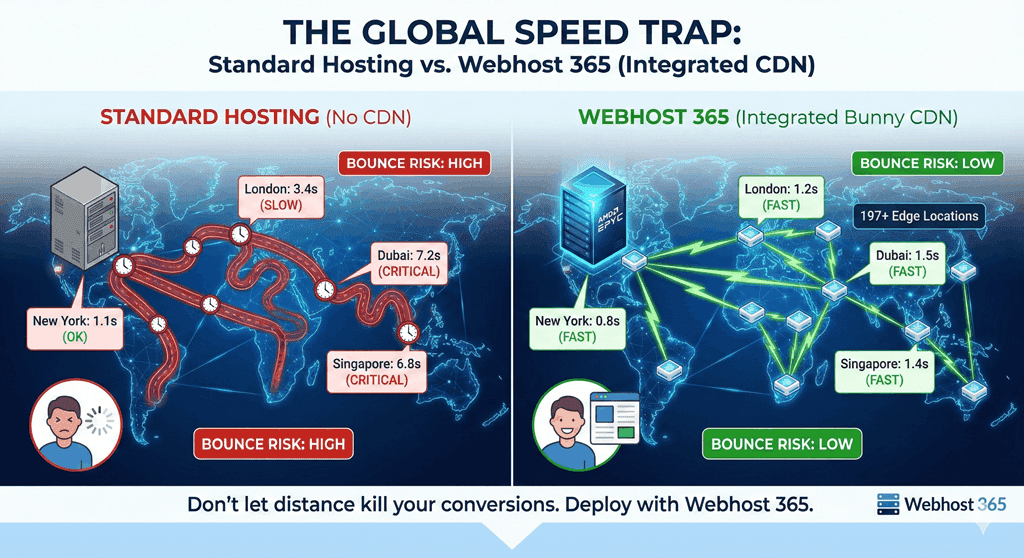
Why the Gap is Growing in 2026
As web pages become “heavier”—incorporating high-res WebP images, complex JavaScript frameworks, and personalized content—the “Distance Tax” has become more expensive.
Without an integrated CDN, every single image request from that visitor in Singapore has to travel back and forth across the Pacific. With over 100+ requests per page on a modern site, those milliseconds of latency compound into seconds of waiting.
The 197-Location Advantage
While many large hosting companies advertise “Global Servers,” they often only have 5 or 6 primary data centers. If your visitor isn’t near one of those five cities, they are out of luck.
Webhost 365 bridges this gap by utilizing 197+ global edge locations.
- The Result: Your content isn’t just “on the web”—it is physically sitting in a data center in the same city (or the very next one) as your customer.
- The Technical Edge: By serving the “heavy lifting” from the edge, your AMD EPYC origin server stays cool and fast, dedicated only to processing the most essential dynamic data.
The ROI of Milliseconds
According to 2026 conversion data, reducing your load time from 3 seconds to 1 second can double your conversion rate. By eliminating the “Invisible Wall” in the UAE, Asia, and Europe, you aren’t just improving a score in a tool—you are literally opening your storefront to millions of customers who previously couldn’t get through the front door.
Beyond Speed: The “Edge” as a Security Fortress
Most users think of a CDN solely as a performance booster. But when you integrate a network like Bunny CDN directly into your hosting stack at the infrastructure level, you aren’t just getting a “delivery” engine—you’re deploying a global security shield.
In 2026, cyber threats are more automated and distributed than ever. Relying solely on a server-side firewall is like trying to defend a castle only after the invaders have already breached the front gates.
1. Absorbing DDoS Attacks at the Source
A Distributed Denial of Service (DDoS) attack works by overwhelming your server with a flood of “garbage” traffic.
- The Traditional Vulnerability: Without an integrated CDN, every single malicious request hits your server’s CPU and RAM. Even if your firewall blocks them, the sheer volume can saturate your bandwidth and crash your site.
- The Webhost 365 Edge: By using an integrated CDN, the attack hits the Edge nodes first. With 197+ locations acting as a buffer, the malicious traffic is “scrubbed” and absorbed across a massive global network. Your actual server (the Origin) never even feels the pressure.
2. Reducing the Attack Surface
When you use our integrated approach, your origin server is essentially “hidden” behind the CDN’s global IP addresses.
- Traffic Filtering: We filter out known malicious bots, scrapers, and “bad actors” at the edge before they can even attempt to look for vulnerabilities in your WordPress or application code.
- Resource Preservation: Because the CDN handles the “heavy lifting” of serving images and static files, your AMD EPYC processor is 100% available to run the security protocols that matter, like real-time malware scanning and encrypted transactions.
3. Global SSL/TLS Termination
Integrated CDNs handle the “handshake” for your SSL certificates at the edge.
- The Performance Win: This removes the heavy computational load of encrypting and decrypting traffic from your main server.
- The Security Win: It ensures that your data is encrypted as close to the user as possible, reducing the window of opportunity for “man-in-the-middle” attacks during the long transit across global networks.
The Bottom Line: Resilience by Default
At Webhost 365, security isn’t a plugin you install; it’s a byproduct of our architecture. By moving the “first point of contact” to the global edge, we ensure that your site stays online and secure, no matter how many miles away your visitors—or your attackers—are.
How to Check Your Own Global Performance
Now that you understand the “Invisible Wall,” it’s time for a reality check. You cannot rely on a single speed test from your own browser to judge your global standing. To see what your visitors in London, Tokyo, or Mumbai are experiencing, you need tools that simulate a global presence.
The “Global Audit” Toolkit
- PageSpeed Insights (Google): This is your baseline. Look specifically at the “Field Data” (Core Web Vitals) rather than just the “Lab Data.” Field data shows how actual users in the real world are experiencing your site over a 28-day period.
- GTmetrix (Location Testing): Don’t just test from the default Vancouver server. Use a free account to test your site from different global regions. If your LCP is 1s in Canada but 5s in London, you have a delivery problem.
- Webhost 365 Performance Checker: Use our native performance tool to see exactly how our Bunny CDN integration would reduce your specific TTFB across our 197+ edge locations.
The “Red Flag” Checklist
If you see any of the following during your audit, your global traffic is likely bouncing:
- Variable TTFB: Your “Time to First Byte” changes drastically (by more than 500ms) depending on the test location.
- LCP Discrepancy: Your main images load fast in your home country but take forever elsewhere.
- High INP in Specific Regions: Users in distant locations experience “lag” when clicking buttons or navigation menus.
Conclusion: Don’t Build a Border Around Your Business
In the digital economy of 2026, there is no such thing as a “local” website. If your content is online, you are a global brand—whether you intended to be or not.
Continuing to use traditional, “center-out” hosting is like building a storefront with a door that only opens for people on your street. By the time someone from another city arrives, they’ve already given up and moved on to a competitor whose “door” was already open.
Performance as a Standard, Not an Option
At Webhost 365, we’ve removed the complexity of global scaling with our Webhost 365 native control panel. You shouldn’t have to be a network engineer to have a fast website in Singapore or USA or India. By combining the raw compute power of AMD EPYC servers with the native, zero-config integration of Bunny CDN, we’ve ensured that speed is “baked in” from the moment you hit “Deploy.”
Stop losing global customers to latency. Demolish the Invisible Wall, fix your Core Web Vitals, and give every visitor—regardless of their zip code—the “instant” experience they deserve.
Ready to see the difference? Experience the world’s only hosting platform with integrated Bunny CDN today.