
Reseller hosting is a business model where you purchase hosting resources from a provider and sell them to your own clients under your own brand. You set the pricing, manage the client relationships, and keep the profit margin. The hosting provider maintains the servers, handles security updates, and ensures uptime. You focus on acquiring customers and growing your revenue.
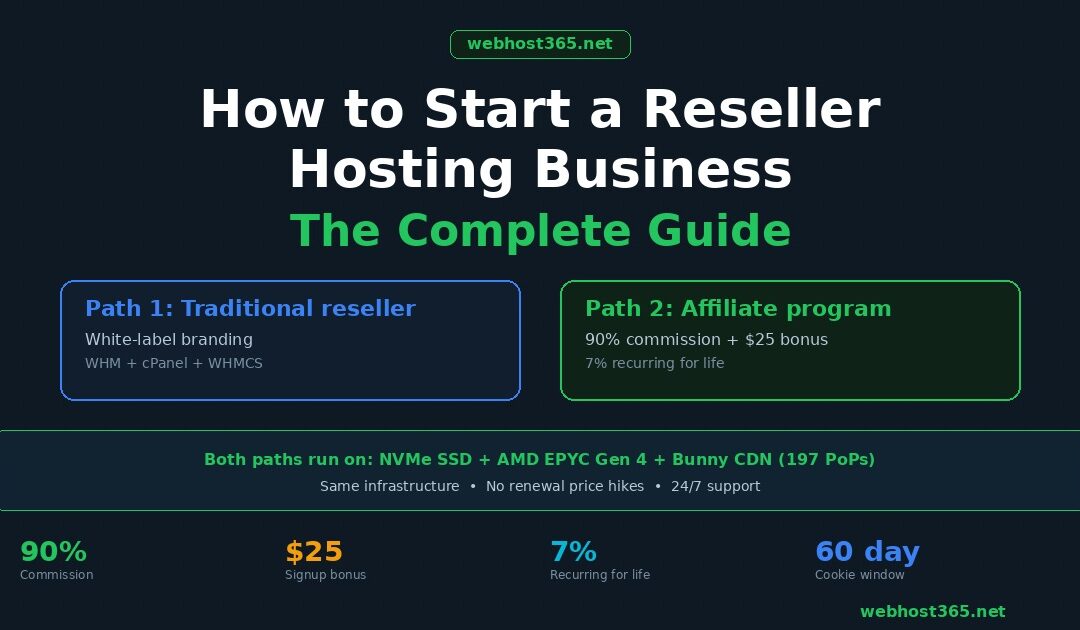
In 2026, there are two distinct paths to earning money from hosting. The first is traditional reselling, where you buy a block of server resources, divide them into individual hosting packages using a control panel like WHM, and sell those packages to your own clients with your own branding. You handle first-line support and billing. The second is an affiliate or referral model, where you recommend a hosting provider to your audience using a unique referral link and earn a commission on every sale without managing any hosting infrastructure or client support.
Both models generate recurring revenue. Both scale with your client base. The difference is in how much control you want versus how much management you are willing to take on.
Webhost365 offers both paths. Their reseller hosting plans give agencies and web designers full white-label control over client hosting on NVMe SSD infrastructure with Bunny CDN. Their affiliate program pays 90% commission on every sale, a $25 signup bonus just for joining, and 7% recurring revenue for the lifetime of each referred customer — the highest commission structure in the web hosting industry. No other hosting provider offers all three: 90% upfront, a cash signup bonus, and lifetime recurring.
This guide covers how both models work in practical detail, shows you realistic revenue calculations at different client volumes, compares the seven factors that separate good reseller providers from bad ones, and gives you a clear framework for deciding which path fits your skills, your audience, and your business goals. Whether you are a web designer looking to add recurring revenue to your client services, a blogger who wants to monetise hosting recommendations, or an entrepreneur exploring low-overhead business models, one of these two paths will fit your situation.
What is reseller hosting and how does it work?
Reseller hosting is a wholesale model where you buy a block of hosting resources — storage, bandwidth, CPU, and email accounts — from a parent hosting company at a bulk rate, then divide those resources into individual hosting packages that you sell to your own clients at a markup. Your clients see your brand, your pricing, and your support. They never interact with the parent hosting company directly.
The mechanics are straightforward. The parent hosting provider gives you access to a server management tool called WHM (Web Host Manager). Inside WHM, you create individual cPanel accounts for each of your clients. Each cPanel account functions as a standalone hosting environment with its own storage allocation, email accounts, databases, and file manager. From your client’s perspective, they log into a professional control panel branded with your company name and manage their website exactly as they would on any other hosting provider. They have no visibility into the fact that you are a reseller.
This division of responsibility is what makes the model work. The parent provider handles everything that requires a data centre and an engineering team: physical servers, network connectivity, hardware replacements, operating system updates, security patches, uptime monitoring, and DDoS protection. You handle everything that requires a relationship with the customer: sales, onboarding, first-line technical support, billing, and account management.
The billing side is typically automated through a tool called WHMCS (Web Host Manager Complete Solution). WHMCS connects to your WHM server and automates the entire client lifecycle. When a new customer signs up on your website and pays, WHMCS automatically creates their cPanel account, sends them login credentials, generates invoices on your billing schedule, processes recurring payments, and suspends accounts for non-payment. Without WHMCS or a similar billing system, you would need to create accounts manually, send invoices by hand, and track payments in a spreadsheet. That works for three or four clients. It becomes unmanageable at fifteen.
The financial model is simple. You pay the parent provider a fixed monthly fee for your reseller plan, which gives you a set amount of total resources. You then sell individual hosting packages at whatever price you choose. If your reseller plan costs $20 per month and you sell ten hosting packages at $5 per month each, your gross revenue is $50 and your profit is $30. Your margin improves as you add clients because the reseller plan cost stays fixed up to the resource limit, while your revenue grows with every new signup.
The model is designed for a specific type of person. Web designers who build sites for clients and want to host those sites under their own brand rather than sending clients to a third-party provider. Digital agencies that bundle hosting with design, SEO, and maintenance contracts to create sticky, recurring client relationships. IT consultants who manage technology for small businesses and want to add hosting to their managed services offering. Freelance developers who build WordPress sites and want a single infrastructure to host all their client projects with centralised management.
If you do not already have clients or an audience that needs hosting, traditional reselling is not the right starting point. The model depends on having people to sell to. The next section covers an alternative model — the affiliate program — that works for people who have an audience but not necessarily direct client relationships.
Reseller hosting vs affiliate programs: which model is right for you?
The biggest decision for anyone wanting to earn money from hosting is not which provider to choose. It is which business model to follow. Traditional reselling gives you full control over pricing and branding but requires technical management and client support. An affiliate program gives you high commissions with zero management but no control over the client experience after the sale. Most guides skip this comparison entirely because they assume everyone wants the traditional model. In practice, the affiliate path is the better fit for the majority of people exploring hosting as a revenue stream.
Here is how the two models compare across every dimension that affects your time, earnings, and daily workload.
| Traditional reseller | Affiliate / referral program | |
|---|---|---|
| How it works | Buy a block of hosting resources, create packages in WHM, sell under your brand with WHMCS billing | Share your unique referral link. When someone signs up through it, you earn a commission |
| Your brand visible to clients? | Yes. Custom nameservers, branded control panel, your company name on everything | No. Clients see the hosting provider’s brand and interact with their platform directly |
| Client support responsibility | You provide first-line support. Server-level issues escalate to the parent provider | The hosting provider handles all support. You have zero support obligations |
| Technical knowledge required | WHM, cPanel, DNS, basic server management, WHMCS configuration | None. You need marketing skills, not technical skills |
| Revenue model | Monthly recurring revenue at whatever markup you set. Typical margins range from 40% to 60% | Commission per sale plus recurring percentage. Webhost365 pays 90% per sale and 7% recurring for life |
| Startup cost | $15 to $50 per month for a reseller plan, plus optional WHMCS licence ($15/month if not included) | $0. Affiliate programs are free to join |
| Time investment | Significant. Account setup, client onboarding, support tickets, billing management | Minimal after initial setup. Create content, share links, earn while the provider does the work |
| Scalability ceiling | Limited by your capacity to provide support. Every new client adds support load | Virtually unlimited. More referrals do not create more work because the provider handles everything |
| Client retention control | High. You control the relationship, pricing, and service quality | Low. The provider controls the client experience after signup |
| Best for | Agencies and web designers who already manage client sites and want to add hosting revenue | Bloggers, content creators, freelancers, and anyone with an audience who recommends tools |
The numbers in that table tell a story most reseller guides ignore. Traditional reselling generates a 40 to 60 percent margin on each client, but every client adds support workload. At 50 clients, you are running a small hosting company with tickets, billing issues, and configuration requests consuming hours of your week. The Webhost365 affiliate program generates 90% commission on each sale with zero support workload. At 50 referrals, you have earned more money than the traditional reseller and spent none of it on client management.
The support burden is the factor most guides understate because it is not visible at five clients. At five clients, support feels manageable. Someone emails asking how to set up their email in Outlook. Someone else needs help pointing their domain. You handle it in fifteen minutes and move on. At thirty clients, those fifteen-minute requests happen daily. At fifty clients, you are spending five to ten hours per week on support alone, which is time you are not spending on acquiring new clients. The affiliate model eliminates this entirely because the provider’s support team handles every client interaction after the sale.
That said, the traditional reseller model has one advantage the affiliate model cannot replicate: brand ownership. When you resell hosting under your own brand, your clients think of you as their hosting provider. That brand association creates loyalty, makes it harder for clients to leave, and positions you as a full-service technology partner rather than someone who recommended a product. For agencies that bundle web design, hosting, and maintenance into a single monthly retainer, this brand ownership is worth the support overhead because it locks the client into a comprehensive relationship.
The two models are not mutually exclusive. A web design agency can resell hosting to clients they actively manage while running an affiliate blog that recommends Webhost365 to a broader audience. The reseller model earns from clients you touch directly. The affiliate model earns from everyone else. Many successful hosting businesses operate both simultaneously, using the affiliate income to subsidise the time they spend on reseller client support.
For anyone starting from zero, the decision framework is simple. If you already manage client websites and want to add hosting to your service offering, start with traditional reselling. If you have an audience, a blog, a social media following, or a professional network but do not directly manage anyone’s website, start with the affiliate program. If you have both, run both.
How much can you actually earn? (realistic revenue calculations)
Reseller hosting and affiliate programs both generate recurring revenue, which means your earnings compound as your client base grows. Every guide on the internet says “reseller hosting is profitable” and leaves it there. Here are the actual numbers using real pricing, real commission structures, and conservative assumptions so you can decide whether the revenue potential justifies your time.
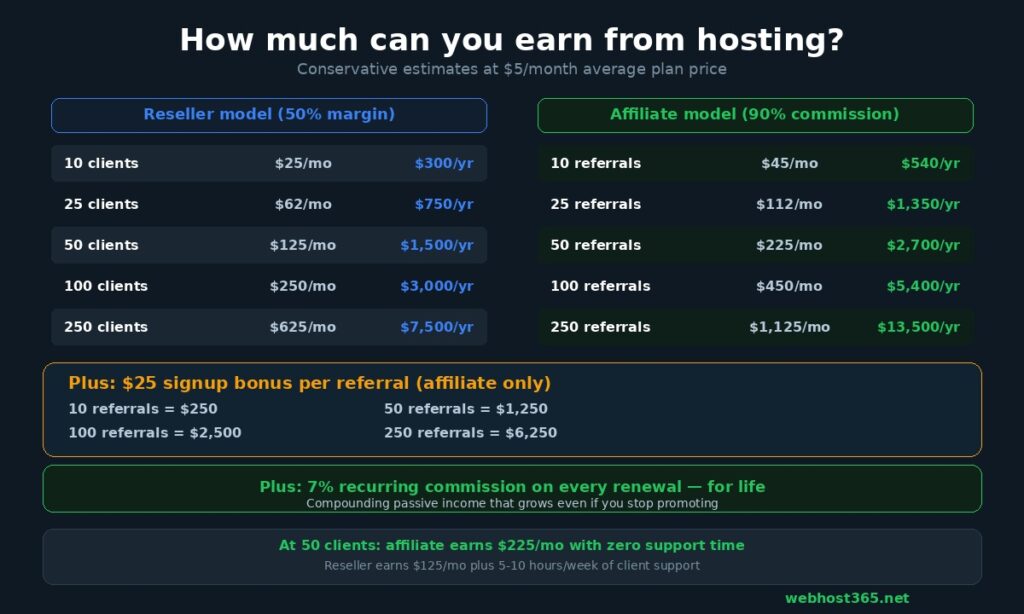
The calculations below use an average plan price of $5 per month, which is conservative. Webhost365 plans range from $1.49 for shared hosting to $22.49 and above for premium tiers. The reseller figures assume a 50% profit margin after your reseller plan costs, which is the industry average. The affiliate figures use Webhost365’s 90% commission rate.
Reseller model earnings (50% margin)
| Clients | Monthly profit | Annual profit |
|---|---|---|
| 10 clients | $25/month | $300/year |
| 25 clients | $62/month | $750/year |
| 50 clients | $125/month | $1,500/year |
| 100 clients | $250/month | $3,000/year |
| 250 clients | $625/month | $7,500/year |
Affiliate model earnings (90% commission)
| Clients | Monthly earnings | Annual earnings |
|---|---|---|
| 10 referrals | $45/month | $540/year |
| 25 referrals | $112/month | $1,350/year |
| 50 referrals | $225/month | $2,700/year |
| 100 referrals | $450/month | $5,400/year |
| 250 referrals | $1,125/month | $13,500/year |
Three things stand out when you compare those two tables side by side.
First, the affiliate model earns nearly double the reseller model at every client level. At 50 clients, the affiliate earns $225 per month versus $125 for the reseller. At 250 clients, the gap widens to $1,125 versus $625. The reason is straightforward: a 90% commission on the full plan price is larger than a 50% margin on a resold package, because the reseller’s margin is calculated after subtracting the cost of the reseller plan itself. The affiliate has no infrastructure costs to deduct.
Second, neither table includes the $25 signup bonus or the 7% recurring lifetime commission that the Webhost365 affiliate program pays on top of the 90% upfront commission. The $25 bonus alone adds significant one-time payouts at scale.
| Referrals | Signup bonus earned |
|---|---|
| 10 referrals | $250 one-time |
| 50 referrals | $1,250 one-time |
| 100 referrals | $2,500 one-time |
| 250 referrals | $6,250 one-time |
The 7% recurring adds a compounding layer on top of those figures. Every customer who renews their hosting generates additional commission for you month after month, year after year, for as long as they remain a subscriber. After two or three years, the recurring commissions from your earliest referrals become a meaningful passive income stream that grows even if you stop actively promoting.
Third, the tables do not account for the time cost difference between the two models. A reseller managing 50 clients spends five to ten hours per week on support tickets, billing issues, and account configuration. That time has an opportunity cost. If you value your time at $30 per hour and spend seven hours per week on support, you are spending roughly $840 per month on unpaid labour to earn $125 in reseller profit. The affiliate managing 50 referrals spends zero hours on support because the hosting provider handles everything. Every hour you would have spent on tickets can instead be spent creating content, building relationships, or promoting your referral link to acquire more customers.
These calculations are conservative by design. They assume a $5 average plan price when many hosting customers purchase $10 to $25 plans, especially for cloud hosting, VPS, or business hosting tiers. They assume a 50% reseller margin when skilled operators who price their packages well can achieve 60 to 70 percent. And they assume linear growth when in reality, hosting revenue compounds — a client acquired in month one continues paying in month twelve, month twenty-four, and beyond, while you continue acquiring new clients each month.
The realistic path for most people looks like this. Month one through three, you acquire your first 5 to 15 clients or referrals through your existing network, client base, or audience. Month four through twelve, word of mouth and content marketing bring steady growth toward 25 to 50 clients. By the end of year one, you are earning $100 to $250 per month in recurring hosting revenue with the affiliate model, or $50 to $125 with traditional reselling. That is not life-changing money. But it is recurring, it compounds, and it requires progressively less effort per dollar earned as your base grows. By year three, with consistent effort, reaching 100 to 250 referrals is realistic for anyone with an active blog, a client portfolio, or a professional network in the web industry.
The question is not whether hosting revenue is worth pursuing. The question is whether you want to earn it by managing client infrastructure yourself or by letting the provider handle everything while you keep 90% of every sale. For most people reading this guide, the affiliate program is the faster path to those numbers.
7 things to look for in a reseller hosting provider
The hosting provider you partner with determines the quality of service your clients receive, the tools available to manage your business, and ultimately whether your clients stay or leave. A bad provider does not just cost you one client. It costs you every client that bad experience touches, plus the referrals those clients would have sent you. Here are the seven factors that separate providers worth building a business on from providers that will undermine you.
1. Server infrastructure (NVMe, processor, RAM)
Your clients’ websites run on the provider’s hardware. If that hardware is slow, every site you host is slow, and your clients blame you — not the provider they have never heard of. In 2026, the baseline expectation for serious hosting infrastructure is NVMe SSD storage, modern multi-core processors, and DDR5 RAM. Anything less is a generation behind.
NVMe SSD delivers data at up to 7,000 MB/s with 0.02ms latency, compared to 550 MB/s and 0.1ms for SATA SSD and 130 MB/s with 5-10ms latency for traditional hard drives. When your client’s WordPress site generates 40 database queries per page load, the storage speed difference is the gap between a site that feels instant and a site that feels sluggish. If a provider does not explicitly state they use NVMe storage, assume they are running on whatever is cheapest.
Webhost365 runs AMD EPYC Gen 4 processors with boost speeds up to 4.2 GHz, DDR5 RAM, and NVMe SSD across every plan tier. That same infrastructure powers both reseller accounts and the affiliate program, which means every client you bring to the platform gets enterprise-grade hardware regardless of which plan they purchase.
2. CDN inclusion
A hosting server sits in one physical location. A visitor on the same continent as the server gets fast load times. A visitor on a different continent experiences 150 to 300 milliseconds of additional network latency before a single byte of content arrives. If your clients serve customers internationally, or even nationally across a large country, that latency degrades their user experience and their Core Web Vitals scores.
A CDN eliminates this problem by caching static content on edge servers distributed around the world. Most reseller hosting providers do not include a CDN. They expect you or your clients to configure Cloudflare separately, which adds DNS complexity and another vendor to manage. Webhost365 includes Bunny CDN with 197 global edge locations on every plan at no extra cost, activated automatically with zero configuration. Every site you host or refer loads fast for every visitor regardless of geography. That is a selling point you can use with your own clients, and it is a performance advantage most competitors cannot match.
3. White-label and branding options
If you are running a traditional reseller business, your clients should see your brand at every touchpoint. That means custom nameservers (ns1.yourbrand.com instead of ns1.parenthost.com), your company name on the control panel login page, your logo in client communications, and no visible reference to the parent hosting provider anywhere in the client experience.
White-label capability is the difference between running a hosting business and being an obvious middleman. If your client discovers they are on a reseller account and can sign up directly with the parent provider for less money, you lose that client and every future client they would have referred. Verify that the provider offers complete white-label branding before you commit to a reseller plan.
For the affiliate model, white-labelling is not relevant because the client interacts with the provider’s brand directly. The tradeoff is that you do not build brand equity in hosting — your brand equity is in the recommendation, not the service itself.
4. Billing and automation (WHMCS or equivalent)
Manual invoicing does not scale past five clients. By the time you reach fifteen clients, manually creating hosting accounts, generating invoices, tracking payments, and suspending accounts for non-payment will consume hours of your week that should be spent on client acquisition.
WHMCS is the industry-standard billing platform for hosting resellers. It automates account provisioning (new client signs up, cPanel account is created automatically), invoice generation and recurring billing, payment processing through multiple gateways, automatic suspension for non-payment, and support ticket management. Some providers include WHMCS free with reseller plans. Others charge $15 to $20 per month for the licence on top of your reseller plan cost. That cost matters because it eats directly into your margins, especially at low client volumes.
The affiliate model bypasses this requirement entirely. The hosting provider handles all billing, account creation, and payment processing. You do not need WHMCS, payment gateways, or any billing infrastructure. Your only tool is your referral link and your affiliate dashboard showing clicks, conversions, and commissions.
5. Support structure
This is the factor that breaks most reseller businesses and the one that guides are least honest about. When you resell hosting, you are your client’s first point of contact for every issue. Email not delivering? Your client contacts you. Site running slow? They contact you. Cannot log into cPanel? You. SSL not working? You.
Some of these issues you can resolve yourself in WHM. Others require escalating to the parent provider’s support team, which means your client waits while you wait. The quality and speed of the parent provider’s support directly determines how quickly you can resolve escalated issues and how frustrated your clients get in the process.
Before committing to a reseller plan, test the provider’s support. Submit a technical ticket and measure the response time. Ask a question that requires server-level investigation and see whether you get a knowledgeable answer or a scripted response. Your clients’ patience depends on this.
The affiliate model eliminates the support burden entirely. The hosting provider’s 24/7 support team handles every client issue directly. You are not in the loop, which means your earning potential is not bottlenecked by your availability to answer tickets at midnight.
6. Pricing transparency and renewal rates
If the hosting provider raises their prices after the first year, one of two things happens. Either you absorb the increase and your margins shrink, or you pass the increase to your clients and risk losing them to a competitor who did not raise prices. Both outcomes damage your business.
This is particularly dangerous for resellers because your clients’ hosting costs are your cost of goods sold. A 50% price increase on your reseller plan at renewal translates directly into a 50% reduction in your profit margin unless you raise your own prices by the same amount. Most hosting providers advertise a low introductory rate and increase it substantially at renewal. For a detailed breakdown of how renewal pricing works across the industry, see our article on web hosting renewal price hikes.
Webhost365 charges the same price at renewal as at signup. There is no introductory discount that triples after year one. The price you plan your business around today is the price you pay in year two, year three, and every year after. For a reseller building a long-term business, predictable costs are not a nice-to-have. They are the foundation of sustainable margins.
7. Upgrade path and scalability
Your business will not stay the same size forever. A successful reseller who starts with a basic plan hosting 10 clients will eventually need more resources for 50 clients, then 100. The hosting provider needs to offer a clear upgrade path that lets you scale without migrating your entire client base to a new platform.
The ideal provider offers a product ladder: shared hosting for small clients, cloud hosting for growing businesses, VPS for clients who need dedicated resources, and dedicated servers for enterprise workloads. If you can move clients up this ladder within the same provider, you avoid the nightmare of migrating dozens of websites, reconfiguring DNS, and explaining downtime to clients who trusted you to handle their hosting.
Equally important, the provider should let you upgrade your own reseller plan seamlessly. Moving from a 20-account reseller plan to a 50-account plan should be a billing change, not a server migration. If scaling up requires you to move to a different server or reconfigure your WHM environment, the provider has not built reselling into their architecture properly.
On Webhost365, the full product range — from free hosting and $1.49 shared plans through cloud hosting, VPS, and bare metal — runs on the same NVMe and AMD EPYC infrastructure. Clients scale up within the same platform. Resellers scale their plans without migrating accounts. And the affiliate model scales infinitely because more referrals never require more infrastructure from you.
How to start with the Webhost365 affiliate program
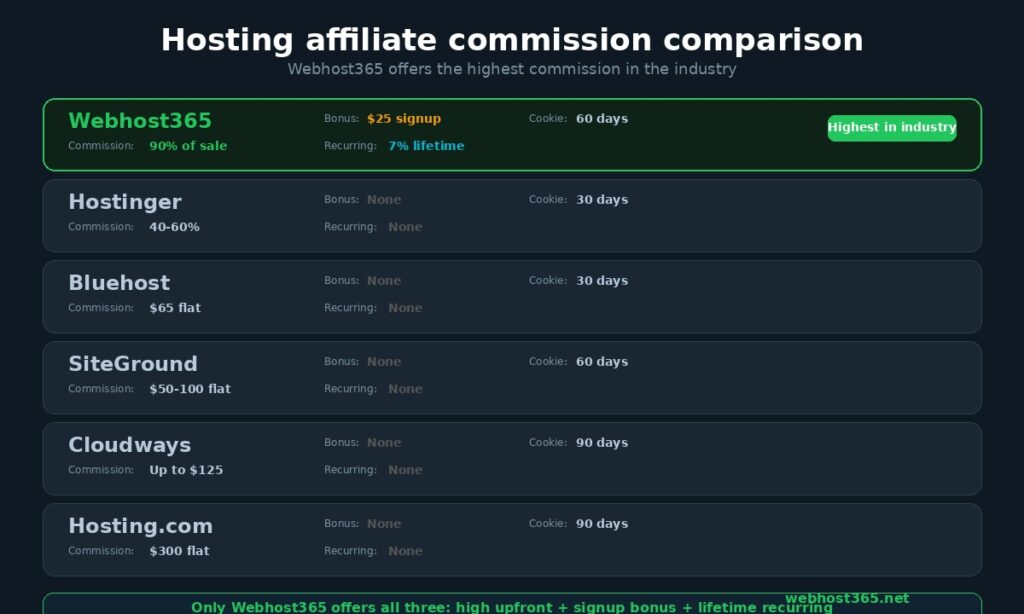
The Webhost365 affiliate program pays 90% commission on every sale, a $25 signup bonus just for joining, and 7% recurring revenue for the lifetime of each referred customer. No other hosting provider offers all three components in a single program. Here is how it compares to every major hosting affiliate program in the industry.
| Provider | Commission per sale |
|---|---|
| Webhost365 | 90% of sale + $25 signup bonus + 7% recurring for life |
| Hostinger | 40-60% (volume-based, no recurring) |
| Bluehost | $65 flat per sale (no recurring) |
| SiteGround | $50-100 flat per sale (no recurring) |
| Cloudways | Up to $125 per sale (no recurring) |
| Hosting.com | $300 flat per sale (no recurring) |
| Provider | Cookie window |
|---|---|
| Webhost365 | 60 days |
| Hostinger | 30 days |
| Bluehost | 30 days |
| SiteGround | 60 days |
| Cloudways | 90 days |
| Hosting.com | 90 days |
The flat-fee programs like Bluehost and Hosting.com pay well on the initial sale but nothing afterwards. If you refer a customer who stays for five years, you earn the same $65 or $300 you earned on day one. With Webhost365, that same customer generates 90% of their first payment, plus 7% of every renewal for five years. A single referral who purchases cloud hosting at $3.49 per month and stays for three years earns you approximately $38 in first-sale commission, $25 in signup bonus, and $8.80 in recurring payments — nearly $72 total from one referral. At scale, the recurring component turns your affiliate income from transactional to compounding.
The 60-day cookie window means that if someone clicks your referral link today but does not purchase until 59 days later, the sale is still credited to your account. This matters because hosting is not an impulse purchase. People research, compare, and deliberate before committing to a hosting provider. A 30-day cookie loses credit for anyone who takes longer than a month to decide. A 60-day window captures the full decision cycle for most buyers.
Getting started takes less than five minutes and costs nothing.
Sign up at webhost365.net/affiliate/ using your email address. There is no application review, no minimum traffic requirement, and no hosting purchase necessary. You receive your $25 signup bonus and your unique referral link immediately after registration.
Place your referral link anywhere your audience is. Write a blog post reviewing or recommending Webhost365. Add a hosting recommendation to your web design portfolio. Include your referral link in client proposals when you suggest hosting. Share it on social media, in email newsletters, or in YouTube video descriptions. The link works anywhere a URL works.
Track your performance in the affiliate dashboard. Every click, every conversion, and every commission is tracked in real time. You can see which referral sources are driving the most signups and double down on what works. The system is fully transparent — there are no hidden attribution rules or delayed reporting.
Collect your commissions. Payouts are processed automatically. There is no minimum payout threshold that locks your money until you hit an arbitrary number. You earn, it tracks, you get paid.
The affiliate model works best when your promotion is genuine and specific. A blog post titled “I moved my client sites to Webhost365 and here is what happened” converts better than a generic “best hosting 2026” listicle because it carries personal experience and credibility. A web designer who tells a client “I recommend this hosting provider and here is the link to sign up” converts at a higher rate than a banner ad because the recommendation comes from a trusted relationship. The strongest affiliates are not professional marketers. They are professionals in other fields — web design, development, consulting, content creation — who recommend a hosting provider they genuinely use and trust.
For traditional reseller hosting, Webhost365 reseller plans provide WHM access, white-label branding, and the same NVMe and Bunny CDN infrastructure available to affiliate-referred customers. If your business model requires full brand control and client management through your own control panel, the reseller path gives you that. But for anyone who wants the highest commission in the industry with zero infrastructure management, zero support obligations, and zero startup cost, the affiliate program is the most efficient path from recommendation to recurring revenue.
Who should start a reseller hosting business?
Reseller hosting and affiliate programs are not passive income shortcuts. They are revenue multipliers for people who already have access to potential hosting customers through their existing business, audience, or professional network. The model you choose depends on what you already have, not on what you hope to build from scratch.
Here is a framework that maps your current situation to the model that fits.
Web designer or developer with active clients
| Best model | Traditional reseller |
| Why it fits | You already build and manage client websites. Hosting is a natural addition to your service. Clients pay you one monthly fee that covers design, maintenance, and hosting. You manage everything in one WHM dashboard instead of sending clients to a third-party provider where you have no control and no recurring revenue. |
Digital marketing agency
| Best model | Traditional reseller + affiliate program (both) |
| Why it fits | Resell hosting to clients you manage directly. Run the affiliate program alongside your agency blog and content marketing. Hosting bundled with SEO and PPC services creates a sticky retainer relationship where clients are far less likely to leave because switching means disrupting their entire digital infrastructure. |
Blogger or content creator
| Best model | Affiliate program |
| Why it fits | You have an audience that trusts your recommendations but you do not manage their websites. A hosting review, a tutorial, or a “tools I use” page with your referral link converts readers into commissions without you providing any technical support. The Webhost365 affiliate program pays 90% per sale, which means a single well-placed recommendation in a popular blog post can generate ongoing passive income for years. |
Freelance WordPress developer
| Best model | Affiliate program |
| Why it fits | You build WordPress sites for clients and hand them off. You do not want the ongoing responsibility of managing their hosting infrastructure. Instead of setting up WHM and handling support tickets, recommend Webhost365 through your referral link during the project handoff. The client signs up, you earn 90% commission plus 7% recurring, and the provider’s support team handles everything after launch. |
IT consultant or managed services provider
| Best model | Traditional reseller |
| Why it fits | You already manage technology for small businesses. Adding hosting to your managed services offering strengthens the relationship and creates another recurring revenue line. White-label branding means your clients see your MSP brand on their hosting control panel, reinforcing your position as their single technology partner. |
Someone with no existing audience or clients
| Best model | Build your audience first |
| Why it fits | Neither model generates income without people to sell to or refer. A reseller plan with zero clients is a monthly expense with zero revenue. An affiliate link with zero traffic earns zero commissions. If you are starting from zero, your first investment should be in building an audience — a blog, a YouTube channel, a professional network, a freelance portfolio — not in purchasing a reseller plan or optimising an affiliate link that nobody will click. |
The last row is the most important one in this framework, and it is the one every reseller hosting guide conveniently omits. Reseller hosting and affiliate programs are distribution models, not demand generators. They work when you have demand — clients who need hosting, readers who trust your recommendations, a professional network that asks you for technology advice. They do not work when you are trying to create that demand from nothing while simultaneously learning how to manage hosting infrastructure.
The honest sequence for anyone starting from zero is: build an audience or client base first, earn trust through valuable work, and then monetise that trust through hosting recommendations or reseller services. Trying to do all three simultaneously is how people end up paying $30 per month for a reseller plan with two clients and $6 in monthly revenue.
For everyone else — the designer with ten client sites, the agency bundling services, the blogger with a WordPress tutorial that gets 5,000 monthly visitors, the consultant who manages IT for a dozen small businesses — one of the first five rows in that framework describes you, and the path from your current situation to recurring hosting revenue is shorter than you think.
Choose your path to hosting revenue
Reseller hosting and affiliate programs are two routes to the same destination: recurring revenue from an industry that grows every year as more businesses move online. The right path depends on whether you want full brand control with client management responsibility, or maximum commissions with zero operational overhead.
Both paths on Webhost365 run on the same infrastructure. Every client you host or refer gets NVMe SSD storage on AMD EPYC Gen 4 processors with DDR5 RAM and Bunny CDN with 197 global edge locations. The pricing stays the same at renewal whether your client is on a $1.49 shared plan or a $22.49 premium tier. No surprise increases, no margin erosion, no awkward price-hike conversations with your clients.
If you want to resell hosting under your own brand with WHM access, white-label control panels, and full client management, start with a reseller plan.
If you want to earn 90% commission on every referral, collect a $25 signup bonus, and receive 7% recurring revenue for the lifetime of every customer you refer — with zero support obligations and zero startup cost — join the affiliate program.
If you want both, run both. The two models are complementary, not competing.
Join the Affiliate Program — 90% commission + $25 bonus | Reseller Hosting Plans | General Hosting — from $1.49/mo | Cloud Hosting — from $3.49/mo | Compare All Plans
Frequently asked questions
What is reseller hosting?
Reseller hosting is a business model where you purchase hosting resources from a parent provider at wholesale rates and resell them to your own clients at a markup under your own brand. The provider handles all server infrastructure, hardware maintenance, and uptime monitoring. You handle client acquisition, pricing, billing, and first-line support. Most reseller plans include WHM for creating and managing individual client cPanel accounts, and optionally WHMCS for automating invoicing and payment processing. The model is designed for web designers, agencies, IT consultants, and freelancers who want to add recurring hosting revenue to their existing business without owning or managing physical servers.
How much money can you make with reseller hosting?
Revenue depends on your client count, your pricing, and which model you follow. With traditional reselling at a 50% margin on an average $5 per month plan price, 50 clients generate approximately $125 per month or $1,500 per year. With the Webhost365 affiliate program at 90% commission, the same 50 referrals on $5 per month plans generate $225 per month or $2,700 per year — with no support costs and no infrastructure expenses. On top of that, the affiliate program adds a $25 signup bonus per referral and 7% recurring lifetime commission on every renewal. Earnings scale linearly with client acquisition, and the recurring subscription model means revenue compounds as long as clients remain active subscribers.
Do I need technical knowledge to start?
For traditional reselling, yes. You need working knowledge of WHM to create and manage client hosting accounts, and enough familiarity with DNS, cPanel, SSL, and email configuration to provide first-line support when clients have questions. If you are a web designer or developer, you likely already have these skills from managing your own projects. For the affiliate model, no technical knowledge is required. You promote a hosting provider using your unique referral link, and the provider handles every technical aspect including setup, configuration, and client support. If you can write a blog post, send an email, or share a link on social media, you have the skills needed for the affiliate model.
What is the difference between reseller hosting and an affiliate program?
Reseller hosting gives you a block of server resources that you divide into individual hosting accounts and sell under your own brand. You control pricing, branding, and the client experience, but you also provide first-line support and manage billing. An affiliate program pays you a commission for referring customers to a hosting provider using a unique tracking link. The provider handles everything after the sale including hosting, support, billing, and branding. You earn money for each successful referral but do not control the client experience once they sign up. Webhost365 offers both models: reseller hosting for agencies and designers who want full brand control, and an affiliate program paying 90% commission plus 7% recurring for those who prefer a zero-management approach. The two models can be run simultaneously.
Is reseller hosting still profitable in 2026?
Yes, for operators who already have access to potential hosting customers. The demand for web hosting grows every year as more businesses establish online presences, and the subscription model means revenue compounds rather than resets each month. The operators who struggle are those competing on price alone against established brands with massive marketing budgets. The operators who succeed position hosting as part of a larger service offering — web design plus hosting, SEO plus hosting, managed WordPress plus hosting — where the hosting component creates a recurring revenue anchor that keeps clients paying month after month even between active projects. Infrastructure quality matters more than ever because clients expect fast sites, and NVMe SSD with CDN is the baseline for meeting that expectation. If you are reselling on a provider with HDD storage and no CDN, your clients’ sites will be slow and they will leave.
Why does Webhost365 pay 90% affiliate commission?
The strategy behind Webhost365’s commission structure — 90% per sale, $25 signup bonus, and 7% recurring for life — is customer acquisition economics. Acquiring a hosting customer through an affiliate costs less than acquiring one through paid advertising on Google or Facebook, and a customer referred by a trusted source (a blog they read, a designer they hired, a colleague they respect) has higher lifetime value and lower cancellation rates than one acquired through a paid ad click. By paying affiliates at the highest rate in the industry, Webhost365 incentivises the most effective acquisition channel while maintaining lower long-term customer acquisition costs than providers spending millions on paid media. The 7% recurring component ensures affiliates remain motivated to continue promoting the service over time, which creates a compounding referral engine rather than a one-time promotion burst.